

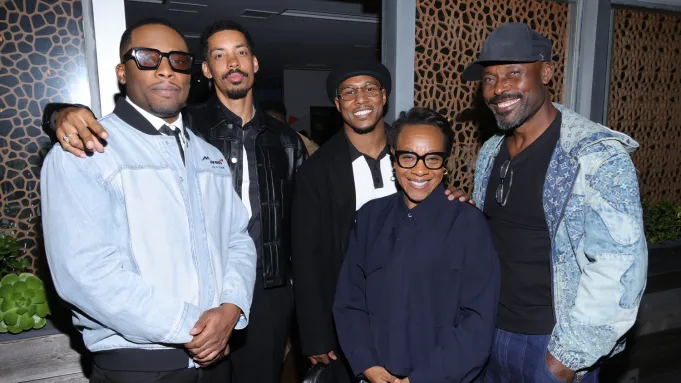
As much of Hollywood pulls back on diversity, equity and inclusion, the British Film Institute is raising a glass instead. Melvin Gregg, Woody McClain and Adrian Holmes were among the stars who gathered in Los Angeles on Thursday, November 12, for BFI America x Gravillis Inc: A Celebration of British and American Black Talent in Hollywood.
The evening brought together actors, filmmakers and industry leaders from both sides of the Atlantic for a night of networking, community and a clear message about the work still to be done.
Guests also included O-T Fagbenle, Aml Ameen, Jimmy Jean-Louis, Amin Joseph and Cory Hardrict, along with director Edgar Wright. Oscar nominee Marianne Jean-Baptiste, filmmakers Thembi Banks and Nneka Onuorah and Carolina Chikezie were also there.
The party was held at Gravillis Inc., the Black-owned Los Angeles creative agency behind some of the most talked-about movie posters of the last decade, including Challengers, Sinners and Michael B. Jordan’s The Thomas Crown Affair. The studio is familiar territory for The Quintessential Gentleman, too: it’s where QG shot its cover story with MACRO founder Charles D. King. Co-owner and creative director Kenny Gravillis, who sits on the BFI’s honorary council, co-hosted the evening.
“Woke is back,” BFI CEO Ben Roberts said in a toast to the room. “It never really went away.” Roberts described the BFI’s mission as “a handshake between the UK and the US,” and encouraged guests to make new connections. “Our communities and industries are so intertwined and well-connected,” he said. “In this room, we want you to meet people and make new connections with people that you don’t know.”
“Over the last few years, the words diversity, equity, inclusion have been considered almost ugly,” Gravillis told guests. “And I love it when a company, especially like the BFI, can actually stand 10 toes down and say, ‘No, actually, we need to do this.’”
The celebration was the BFI’s first event of its kind in the US. It grew out of the organization’s community-building work at international festivals, including its Black women’s lunch in Cannes, which started with 12 women and grew to 220 attendees by its fifth year. Melanie Hoyes, the BFI’s senior director of inclusion, said those gatherings began with a common frustration. “Everybody was telling us, ‘Well, I always feel like the only one in the room,’” Hoyes told Deadline. “And so we were like, ‘But hang on, we know all of these people, and you guys have never met.’”
Hoyes said the timing for a Los Angeles event felt especially important. “At this moment when DEI is kind of being dialed back across the industry, and especially in the States, we are still out here doing that work,” she said. She noted that DEI remains a central part of the BFI’s 10-year strategy. The organization’s diversity standards have also helped shape the inclusion standards adopted by BAFTA and the Academy.
The evening also touched on a more complicated conversation: the ongoing debate over British Black actors landing Black American roles. Hoyes pointed to David Oyelowo, who has said he left the UK because he couldn’t find the roles or stories he wanted to tell there. She said the BFI wants to celebrate British talent thriving abroad while still pushing for more opportunities at home.
For Hoyes, the night came down to one message for Black creatives on both sides of the Atlantic. “You hear a lot of this: ‘We don’t have enough people. We can’t find people. They’re not talented enough.’ And I know that’s not true,” she said. “So I just really want to say that we see you.”
Photo Credit: Arnold Turner/Getty Images for BFI America