

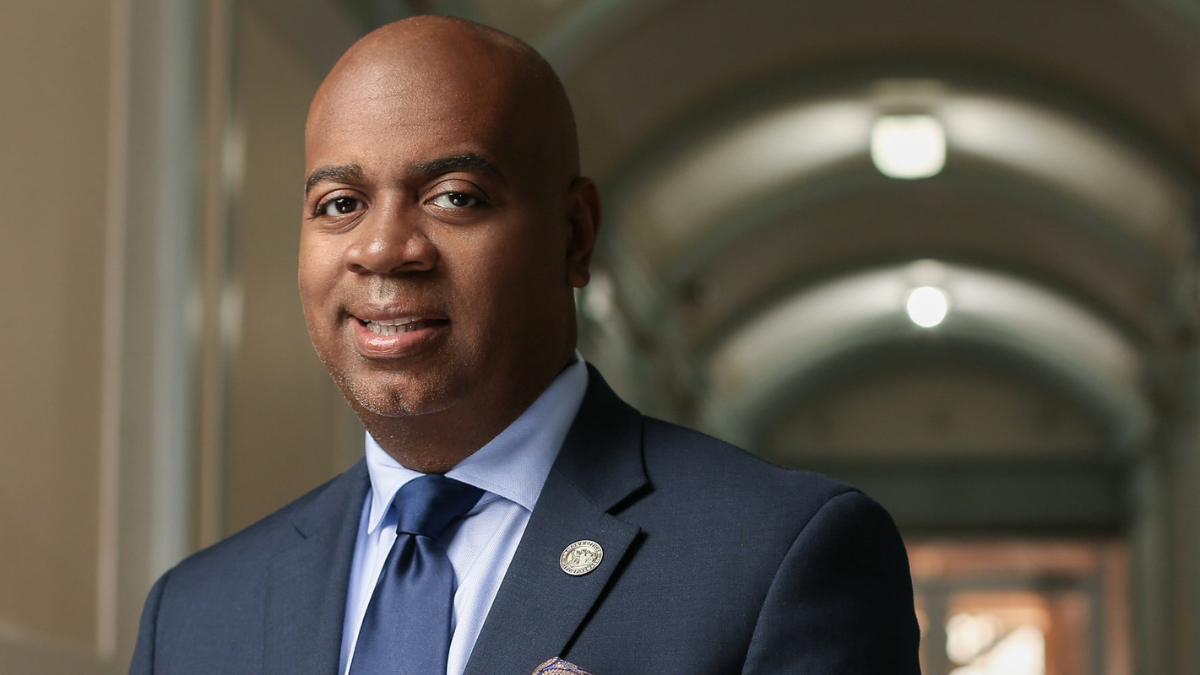
Ras Baraka’s family has called Newark home for more than 80 years, and he has led the city since 2014. Before he became mayor, he was known around the city as a teacher, a poet and a community activist, and as the son of the late poet and activist Amiri Baraka, he grew up surrounded by both the art and the struggle of Black Newark.
In his time in office, he has watched the skyline rise, new housing and development take shape and the city’s neighborhoods transform with new waves of residents from across the globe. As he puts it, if you were a kid who left Newark and came back today, it would be almost unrecognizable.
Now, Newark is drawing attention for a different reason. In the first half of 2026, the city posted a 64.7% decline in homicides, the steepest drop among 66 major U.S. law enforcement agencies surveyed. Baraka says the drop is no accident.
It comes from what he calls an “ecosystem,” in which community violence intervention workers, police, social workers, universities and local hospitals work together and treat violence as a public health issue rather than an emotional one.
The city also starts its summer programming earlier, focuses on its most vulnerable neighborhoods and sends outreach workers out late at night to get young people home safely and connect them with jobs and mentorship.
Newark isn’t alone. Across the country, major cities led by Black mayors, including Baltimore, Birmingham, Chicago and Memphis, have seen crime and violence fall to historic lows. Yet these wins rarely make national news, and the leaders behind them rarely get credit on the national stage.
Baraka believes that silence is purposeful, especially at a time when national leaders are pushing a very different approach to public safety. He also reveals something most people don’t know: many of these mayors have been quietly talking to one another behind the scenes, sharing strategies, sending their teams to each other’s cities and borrowing what works.
For Baraka, the work goes beyond the numbers. Over his years in office, the former activist says he has learned that telling people how bad things are only makes them less likely to get involved, and that hope is something people need to keep going. He’s also candid about the extra weight that comes with being a Black man in leadership, where the expectations are different and people are quicker to question whether you’re smart enough or prepared enough for the job.
We sat down with Baraka to talk about what’s behind Newark’s historic drop in homicides, the pressures of leading as a Black man, what national Democrats are missing heading into the midterms and the Newark that outsiders still don’t see.
[Interview has been edited for length and clarity]
Your family has been in Newark for more than 80 years. What has changed about the city since those early days?
Baraka: A lot of things have changed. The city’s landscape has changed, whether you’re talking about the decrease in violence or the kind of housing and development that’s going on. The skyline is changing. The different demographics of people have changed in the city. If you were a kid and you went away and came back, it would almost be unrecognizable.
What has stayed the same?
Baraka: Though people’s income has increased, poverty is still an issue. Access to housing and quality housing still is an issue. Some of the things that go on in people’s households are the same. And just trying to address the trauma that people carry from generation to generation. Most of those things are cyclical and they continue in this community. Our relationship to the larger folks that are in power is basically the same.
You’ve been in office since 2014. How has your definition of what it means to lead a city changed since you first started?
Baraka: Things are a lot more complex than I might have thought it was. And I understand the necessity of collaboration and that you have to have different forms of struggle. Our fight takes on different forms. And a lot of times we argue with each other about the form that somebody else is involved in without understanding that on a team you need a first baseman and a shortstop. You need a quarterback and a wide receiver. You can’t just have one.
When I’m talking to a mother in a home, just lost their child on the street, or somebody who just lost their SNAP benefits, or people trying to find housing that have become a part of the unhoused, all of the issues that people face every single day, hope is necessary for them to get up and try it again the next day. It’s not just our job to provide material well-being to people but also the kind of emotional well-being and spiritual well-being as well.
It’s important for us to make people think that they’re going to win. I don’t have the luxury of pessimism. I can’t organize and lead from the framework of everything is falling apart. When I was doing the activist stuff, you always tell people how bad things are because you think that’s going to motivate them to get engaged. And what I found out in this job is that the more you beat people up, the less engaged they become. What makes you fight is your confidence that you can win. That’s really the difference, right? Trying to give people the confidence that things are going to change, and it’s one small victory at a time.
What’s the hardest part about being the mayor of Newark?
Baraka: People only know the mayor, the governor and the president of the United States. So they think the mayor is responsible for everything. Anything that goes wrong, they think that the mayor has got a button in his office, he presses it, and everything changes. That’s really not it. You obviously have to work with dozens and dozens of different people to get things to happen, in different levels of government, the private sector, so forth and so on. People think that you’re just having conversations with everybody who think like you, who want what you want. Unfortunately, that’s not how this thing is. You often have to be in places you don’t want to be and talking to people you don’t want to talk to and negotiating with folks that are diametrically opposed to what you are for.
You’ve been praised by grassroots organizations as well as the White House, two audiences that don’t always agree. What does it take to build credibility on both sides?
Baraka: I think ultimately it’s about sticking to what you believe in and still getting things accomplished at the same time. And it’s hard to do. First of all, it’s more difficult to be a Black man as the mayor or leader. For us, the expectation is different. The way people view us and look at us is different. We’re always not smart enough. We’re not prepared enough for all those things. So you’re fighting with all of that and trying to do these things at the same time.
Making sure that you still have some proximity to the folks in your community. People can still see you believe and fight for the things you believe and fight for, whether you are successful at it or not. And then the other side of it, the pragmatic side, is that you can deliver. And if you can deliver on these things, people respect that no matter what level they’re in, because they see you’re trying to do difficult things.
Black mayors are leading major American cities to historic lows in crime and violence, but those achievements rarely make national headlines. What are your thoughts on that lack of visibility?
Baraka: I think it’s purposeful. One, we have a national government now with folks that are trying to take credit for all of that. Based on their Gestapo tactics and foolishness that’s running around, and it’s actually the opposite. And it like flies in the face of everything these people believe in or think is what reduces violence and crime. The opposite of that is actually what’s getting it done. All over the country, might I add, this stuff is working everywhere. It’s not working in Newark. It’s working everywhere that everybody is doing it, it’s working. The tighter you get it, the larger the ecosystem you build, the greater the results will be. People understand that, and we have to fund it and continue to fund it. So I think it’s incredibly purposeful.
You got a couple of people that are out there that are getting a lot of accolades for this, which is good. But by the way, the circle is small of the mayors who’ve actually been talking to each other in the beginning, and now it’s expanding. And most of the places where you see these things happening, that’s successful, the mayors and their teams have consulted with each other. Folks don’t know that. They don’t understand that the mayor of Birmingham and the mayor of Baltimore, me, and the mayor of Chicago – all these places, Memphis – we send people to each other’s cities. We talk to each other. We’re taking cues from one another, and then we give credit to each other in public, because we know I just got this from Baltimore, I just got this from here, I just got that from there. We’re just making it fit where we are.
Newark posted a 64.7% decline in homicides in the first half of 2026, the steepest drop among 66 major U.S. law enforcement agencies surveyed. What do you point to as the biggest driver?
Baraka: The ecosystem that we’ve created, the consistency in that and its relationship to law enforcement. A lot of cities are doing better than they were because they set that up, but they still have that gap between the CVI (community violence intervention) organizations, and city government. The fact that we brought it together, and we still have gaps. By the way, I think that is helping us witness what we witnessed. CVI organizations are at police CompStat, where they get together and talk about these things.
And we treat it scientifically. So we use data. We treat it like it’s public health; it’s a public health strategy. It’s not this emotional thing that people think, “We just got a bunch of formerly incarcerated people running around the streets.” That’s not how this thing works. These people are trained. They’re professional. Whether they were formerly incarcerated or not, they’re still trained. They’re still certified. They’re still out here doing the work that they do, and dangerous work at that. And there are social workers involved. The universities are involved. Local hospitals are involved. So it’s not by happenstance.
Heat and crime usually go hand in hand during the summer months, but Newark was able to keep violence down. How?
Baraka: You got to turn it up. We used to start our summer stuff at the end of June when the kids got out of school. But we realized that the violence in the summer began to turn up in May. So we pushed our programming to May. We opened our pools a month to a month and a half earlier. Our rec centers, all the other kind of things. And then we coordinate all of the programming in the city in one big way, and we concentrate on areas where we call them hot spots, where violence is the most prevalent.
So we hire more kids. We pull out these kids that are justice affected, that are involved in violence, and we let them work, but we also give them a specialized program that’s geared specifically towards kids who more likely would be involved in engaging in violence. We do that very specifically and intentionally because we know they need more than everybody else.
Your summer youth curfew initiative reached a couple thousand kids this summer. What did that program look like on the ground?
Baraka: It’s really run by the Office of Violence Prevention. People think it’s a police thing, but the Office of Violence Prevention runs them. So they basically got vans, and you got the outreach workers, some social workers. They see a kid, 13, 14, 15 years old, that’s out. They pull over, “Yo, what’s going on, where you supposed to be?” Really, they’re just taking them home. So you’re getting a ride home. But in that process, they’re having conversations. It might be something going on in this house. Kid might be upset. You might need something. They ask them, are they employed? “What’s going on in your household?”
And out of that trip, they might pick up a summer job. They might pick up an opportunity to go to a program. They might find out a mentorship thing that they can get involved in. I know when I was 14 and 15, I couldn’t even be on a porch at one o’clock. So at the end of the day, if you’re walking up and down the street, something’s going on. You get a free ride home if that’s all you need. If you need some other stuff, you get an opportunity to try to offer you that.
With the midterms coming up, what do national Democrats get wrong when they talk about urban crime and public safety?
Baraka: They get talking points, they’re talking to pundits and talking heads and sometimes these polls. My brother used to say, when I was first running for office and the polls come out, “I know who they didn’t poll.” Like, these guys ain’t polling our folks. The reality is they’re not embedded in these communities, and they don’t have a real sense of, especially what Black men feel and think about what’s happening in the national scene and how it affects their individual lives.
They just tell you how the other person is wrong. Well, we know they’re wrong. We want to be right, though. You got to convince me how this is going to change my individual trajectory. And ultimately, I think the Democrats, they run for office, but we have a problem with governing, and we have to get better at governing by delivering things for people. We’ve been fighting to protect SNAP and Social Security, but we haven’t created a program like SNAP or Social Security in a long time.
What do you want people outside of Newark to understand about the city that they still get wrong?
Baraka: Newark is a very, very diverse city. It is a city of multiple nationalities. It always has been. Whether you’re talking about Haiti or West Africa or Brazil or South Carolina, right? This is what Newark is made up of. And it’s a working-class community. People, especially in New Jersey, they think everybody in Newark is just on Section 8, struggling at the bottom of the bottom. The majority of the residents are hard-working families that are doing the best that they can with very little resources, making it work for their family with meager salaries.
And I think people mistake our city for News 12 or something they saw on Channel 7 or 2, as opposed to the families that come here every single day and raise their children in very difficult situations and do a damn good job.