

In April 1977, Judy Heumann and a coalition of disabled activists took over the federal building in San Francisco. They refused to leave until the government enforced Section 504 of the Rehabilitation Act, a law that barred discrimination against people with disabilities in federally funded programs but whose regulations had sat unsigned for years. The sit-in stretched on for nearly a month, the longest occupation of a federal building in U.S. history.
It ended when Health, Education and Welfare Secretary Joseph Califano signed the regulations. Behind the scenes, the protesters had help from an unexpected ally: the Black Panther Party, which fed them every day they were inside.
That story is now on screen in Being Heumann, streaming on Apple TV. Directed by Siân Heder, who made CODA, and co-written with Rebekah Taussig, the film is adapted from Heumann’s memoir Being Heumann: An Unrepentant Memoir of a Disability Rights Activist.
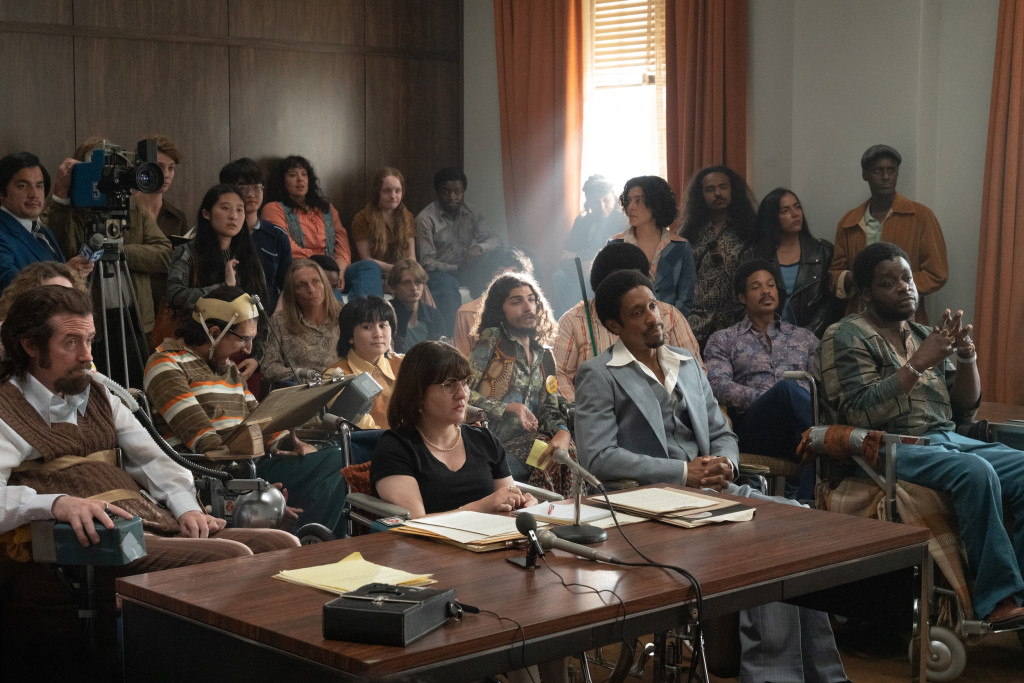
Ruth Madeley stars as Heumann and Mark Ruffalo plays Califano, with Dylan O’Brien, Madeline Delp and Rob Delaney also in the cast. Antwan Tolliver plays Brad Lomax, the Panther and disability activist who brought the party into the fight. Ray Fisher plays Chuck Jackson, Lomax’s fellow Panther and friend.
For Fisher, joining the project was an easy decision. “I said I just want to be a part of it in any capacity,” he told The Quintessential Gentleman. “I’ll do craft services, I’ll hang out, whatever you want, whatever you need. I just want to be a fly on the wall for this process, because this is clearly something that is necessary and something that’s going to be just massively impactful.”
When the project first came to him, Fisher’s team suggested he watch Crip Camp, the documentary about the disability rights movement. “I was floored,” he said. “I was floored about all the things that I learned and all the things I did not know.” The script sealed it for him, along with Heder’s commitment to casting people from the disability community. “This is probably the most necessary film I’ve ever worked on,” he said.
By the time cameras rolled, both Lomax and Jackson had died. So Fisher went to the person who knew them best: Glenn Lomax, Brad’s brother and a fellow Panther. Glenn told him that friends called Jackson “Chucky,” and he walked Fisher through who Jackson was as a person.
He explained that Brad and Chuck stayed friends until Brad’s death, and he shared photos of the two together that the public has never seen. “We got to see pictures that no one’s ever seen before of them together,” Fisher said, “and probably no one ever will see unless Glenn decides to share them with the world.”
For Fisher, honoring the Panthers’ contribution was a big part of the assignment. He believes the movement wouldn’t have survived without them.
“The movement itself would have collapsed really early on had the Black Panthers not intervened and actually provided for the movement,” he said. “That contribution, I think oftentimes in the history of things, and this happens with us as Black people in this country and around the world, ends up either getting minimized or forgotten. It also becomes the responsibility of those telling the story to make sure that people don’t forget.”
He points out that the Panthers understood their fight was connected to others. “It wasn’t just civil rights for Black people,” he said. “They understood that civil rights for Black people were tied into disability rights. They realized it was tied into LGBTQIA+ rights. Because if you can marginalize one group of people, you can do it to other folks. You just go down the line and do it one at a time.”
The film also shows a side of the Panthers that rarely makes it onscreen: not guns and marches, but hot meals. Fisher connects that to the party’s free breakfast program for schoolchildren.
“If a person’s not fed, they’re not going to learn,” he said. “It all starts with the basic human rights.” He praised the film’s portrayal of Panther leader Ericka Huggins for blending the party’s power with its compassion. He also noted that the Panthers “would not have been as successful as they were were it not for the women that were a part of the movement.”
And he credits Heder for making the Panthers’ arrival a standout moment. “You feel the style of the movie even take a different shift,” he said. “That’s just master filmmaking.”
Fisher, best known to many as Cyborg in the DC films, has also played real-life Black icons, including Muhammad Ali onstage and Ed Dwight, the first Black astronaut candidate. He says playing real people comes with a different kind of pressure than superhero fandom.
“You still have family members of folks who are alive,” he said. Whenever he can, he reaches out to the person or someone close to them “to get the best possible sense, and just to ask the blessing.”
“Everybody can have their opinion about what superhero could beat who, and that’s great for the fictional world those characters live in,” he said. “But we got real-world things that we need to deal with right here and now.”
Being Heumann is streaming now on Apple TV.
Photo Credit: DepositPhotos.com/Apple TV