

DéVon Christopher Johnson didn’t wait for the media industry to make room for Black men. He built the room himself. A Queens-born, Harlem-based New Yorker, Johnson cut his teeth in music during hip-hop’s golden era. He started as an assistant at Def Jam and later became a marketing manager at Atlantic Records.
In 2006, at a moment when print was shaking and digital was rising, he launched Bleu, a print magazine created to show Black men as he actually knew them: his friends, his family and his community. He launched it the same year he says 3,000 magazines closed. Twenty years and 110 issues later, Bleu is the flagship of BleuLife Media Group, which spans print, digital, podcasts and events.
In June 2020, as brands rushed to post statements of solidarity after the murder of George Floyd, Johnson saw the gap between those words and the investment Black-owned media was actually receiving. Along with Rhonesha Byng, founder and CEO of Her Agenda, he co-founded the Black Owned Media Equity and Sustainability Institute, known as BOMESI.
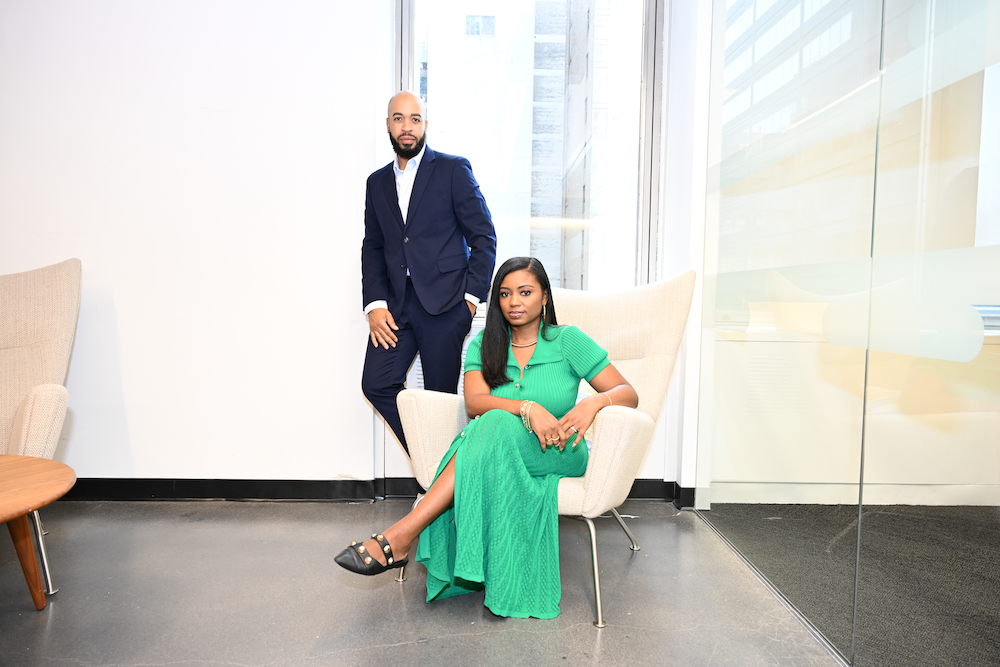
The nonprofit began as a group text among a few frustrated media owners. It has since grown into a network of more than 350 independent Black-owned media outlets, built on three pillars: education, ecosystem and economic empowerment. BOMESI has hosted six summits, two in Tulsa’s historic Greenwood District and three in Detroit, and it runs the BOMESI Accelerator, a program designed to help Black-owned media companies build sustainable businesses.
The Quintessential Gentleman is proud to be a graduate of the accelerator’s fourth cohort. Applications are now open for Cohort Five, which for the first time will bring creators into the program alongside publishers. The cohort will include five publishers, five creators and one creator-in-residence. Eligible businesses can publish through a website, newsletter, podcast, video channel or app, as long as they produce original content, have an owned audience such as an email list or site traffic, and are legally formed in the United States. They must also bring in between $50,000 and $1 million in annual revenue and have fewer than 20 employees.
Johnson describes the state of Black media as a kind of “suspended animation.” The same arguments made in the 1960s and ’80s are still being made today, and the industry has rarely supported more than one major Black-owned outlet at a time.
When that one outlet struggles, he says, the community starts over again. Meanwhile, advertisers will pay a legacy magazine for a Black cover star but won’t put the same dollars behind Black-owned platforms that put Black faces on their covers every issue. Add in AI platforms scraping content without paying for it, and the pressure on independent Black media is real.
Johnson’s answer is to push forward anyway, because, as he puts it, if our stories don’t live, then we don’t exist.
We sat down with Johnson to talk about his journey from Def Jam to Bleu, the founding of BOMESI, what the next cohort will look like, and what real support for Black media looks like.
[Interview has been edited for length and clarity]
Before getting into the publishing industry and creating a media space, you’ve been in the music industry. What did that work look like prior to going out on your own?
DéVon: I worked in the music industry when the music mattered, the artists mattered, the relationship with the audience mattered. I worked in music at a time when people bought CDs and bought albums. I was an assistant at the time at Def Jam when I first started. My last job was as a manager, marketing manager at Atlantic Records, partnership with Asylum Records. But as an assistant fresh out of college, my job experience prior to that was working at the Gap. I was a denim specialist because I folded jeans really well.
I remember, you know, Jay-Z would be in a studio not telling anyone and we’d find out the day before. He’s like, “Yeah, music’s ready. I want to drop the album on Thursday.” It was Tuesday night. So by Wednesday, the marketing plan had to be ready and the rollout for Thursday had to go. And I think that sort of cooking under pressure has stayed, stayed with me.
In 2006, you launched Bleu Magazine, a print magazine, right as digital started to pick up and print started to shake. What was it about that time that made you want to start Bleu?
DéVon: Listen, I’m an idiot. Basically, that’s what that is. I make jokes when I’m on panels that I’m one of the original AIs. So I was arrogant and ignorant to the amount of work that was ahead of me, the amount of headwinds, and the lack of financial interest in investing in print magazines. It’s like me running to the fire instead of running away from it. But I knew beyond starting a magazine for financial gain, I had something to say. And I was more purpose-driven than profit-driven at the time.
By that time, I knew that the image of Black men in media didn’t represent myself or my friends or my parents or my grandparents or my cousins or my neighborhood. And I wanted to not be a complainer on the sidelines. And I grew up in a household that had Ebony Magazine, Jet Magazine, Essence Magazine, even Ebony Man Magazine, Russell Simmons’ One World Magazine on the coffee table. So I was used to looking at reflections of myself and touching the pages and feeling the pages and flipping through them.
And yes, I think 3,000 magazines closed the year that I launched. And luckily, we were not one of them. I put my business plan on AngelList and I was able to get an angel investor in the middle of 3,000 magazines folding. I remember getting an eviction notice from my apartment the day before Christmas of 2007 and calling the investor. And he advanced the money and I was able to not get evicted from my apartment. I put everything into this project, but I never gave up, and somehow the universe, God responded to me not giving up. And out of nowhere, I got an investor, and here we are 20 years later.
Do you think print will come back?
DéVon: I do think print never went away because we printed for 20 years straight, 110 issues, 110 covers produced by us, original content, but it has changed. I don’t think print will ever come back the way it used to be because at that time, print was greedy because it was the only way to advertise, right, before digital. I don’t think the consumer interest in touching and feeling a product has gone away. We are humans. We do use our senses. So it isn’t that people weren’t reading. It became too expensive to produce a million copies of a magazine 300 pages thick, right?
There have been magazines for Black men in the past. However, compared to Black women, there are very few of us creating media platforms. What are your thoughts behind that?
DéVon: I think the greater societal understanding of the Black male consumer is fully misunderstood. No one actually does a good job of marketing to me. No one knows what I eat, what cereal, what kind of milk I drink. No one knows. And maybe ’cause no one cared for such a long time. So because no one cared, no one did the research. So people like you and I are like, wait, like, how come no one’s talking to me? How come no one’s marketed to me? And let me create that platform.
I think it’s really important that we can celebrate Black men without diminishing the amount of hard work and the struggle that Black women have, right? I think oftentimes in rooms when I’ll say that I represent a platform that celebrates and supports Black men, the response is always, “What about Black women?” Like, why can’t both be great and be good and be supportive and get the help, mental, social, economic help that we both need, right? I’m proud of a single mom that did an amazing job, and I adore and love and worship the ground that she walks on. But it doesn’t mean that I have to also not celebrate myself.
But also, we have to let these marketers and decision makers know that they’re losing out on a huge disposable income, whether it’s a married man or a single man, because we don’t know where to spend our money because no one’s telling us there’s products for us, right?
What are your thoughts currently about the state of Black media?
DéVon: I think the state of Black media is this sense of suspended animation, because what we’re saying now is no different than what was said in the ’80s or said in the late ’60s when John Johnson started Ebony Magazine. What happens is we really only allow one to exist. But if we only put all our baskets in one and that one doesn’t do well, there’s no one else to take its space. So every 10 years, we’re starting over again and creating a Black-owned media ecosystem, marketplace, and a consumer-driven product.
If you think of, like, Town & Country magazine, 175 years old. On their 175th anniversary, they put Pharrell Williams on the cover. So they were going to, advertisers are going to give Town & Country all the money for this amazing cover of this amazing, brilliant Black man on the cover. But we, too, have amazing, brilliant Black men and Black women and Black families on our covers, but they don’t put the money towards us. So the system itself was never built for us to survive or to thrive.
This is the time, I think, that we have to put our foot on the gas and not look left or right and look forward. Because if we don’t do that, not only will we not be in business, but our stories won’t live. And if they don’t live, then we don’t exist.
What is BOMESI?
DéVon: I think the best way to say it is a community of creators, journalists, media folks that are trying to do that thing I just said: is keep our foot on the gas. And if my foot gets weak, there’s someone next to me to put their foot on the gas also. So we have three pillars that we stand behind: education, ecosystem, economic empowerment.
And it was started by myself, and I have a co-founder, Rhonesha Byng, who’s also an independent media owner. She owns Her Agenda. And what was happening in 2020: George Floyd was murdered, Black Lives Matter, the pandemic, Black squares, all these different things were happening, and brands were making these statements like, “Oh, we see Black people now,” basically. And I’m like, okay, that’s BS, because at that time, I think I was 14 years with Bleu, having a really hard time getting brands to make that investment in Black storytelling. And so many other people had the same story.
I slept on it, and Sherrell Dorsey, who’s a brilliant investigative and climate journalist that’s part of the BOMESI ecosystem, she was like, “Do something.” And I came back with, “I think I want to start a nonprofit.” And then she actually rearranged the words to Black Owned Media Equity and Sustainability Institute, which became BOMESI. So it took a village to make BOMESI happen.
We’ve grown from that initial text message of three people to 10 to 15, now 350-plus Black-owned media, independently owned outlets in our public face and database. And we’ve, you know, we’ve produced now five BOMESI Summits, two in Tulsa, Oklahoma, three in Detroit. We’ve graduated 31 creators and founders from the BOMESI Accelerator.
QG: So what happens at the summit?
DéVon: So we bring together between 250 and 300 media owners, agency representatives, media buyers, media planners, marketing strategists into a room that oftentimes looks like the rooms that we are left out of. I’ve been able to go to so many conferences, speak on so many stages, but I look out in the audience and there’s maybe one or two people that look like me, and most likely one of those two came with me. Let’s create our own summit or media conference that we now tell brands to come to.
And we started in the Greenwood District of Tulsa. It was around the same time the city was celebrating the 100th anniversary of the Tulsa Massacre of 1921. And I did some research and I realized that there were several newspapers and magazines in that district. They were all burned out. So one way to get rid of a story, not just its people, but also you burn all the materials, you burn the books, right? So people can’t read about themselves. So it was really important for us to be rooted in a space like that.
It’s not just a conference, because you can do that anywhere, anytime, anywhere. This is really almost like a homecoming of folks that are in the same space as you, but not sitting in misery, sitting in how do we move it forward.
Can a creator be a journalist?
DéVon: I’m going to try to be neutral because I’m pretty neutral on it. I am a journalist. I have a degree in journalism. I do believe that a creator can be a journalist if they do those things, the checklist of fact-checking, background information, interviews, all of the things that make a story, reference points, those sort of things. They’re not a journalist just because they posted something. But can they learn the skill? Absolutely. I think they should learn the skill, because credibility matters. If you want to be taken seriously.
If you think about all of the one-hit wonders. They were like, “Yeah, my album was hot,” and then no other album, never heard from it again. And I think that’s going to happen to creators if they don’t figure out a way, or we don’t help them figure out a way, to make a real business out of what they do.
As it pertains to AI and the publishing world, I want to know the benefits and the harms that people need to be cognizant of.
DéVon: I am not afraid of AI. I think AI is amazing. I create business concepts in my sleep. I wake up out of my sleep, I write notes down, and it’s been a really great way for me to organize, organize my thoughts. So the tool of AI as a partner, thought partner, organization partner, and the utility of it, I think it’s amazing.
When it comes to how large LLMs are scraping millions, billions of data points of work that they didn’t do, that is concerning, right? Because, like you said, the economic implications are an audience member doesn’t have to go to my site anymore for this fact. I do hope the large language model platforms respect the fact any cultural content that their product references comes from this community that we’re part of. They need to compensate. I don’t just need you to credit my name. I don’t need you to credit Bleu. That’s great. Thanks for the honorable mention, thanks for the tag. I need you to cut a check, because you’re cutting checks to Hearst. You’re cutting checks to Condé Nast.
It’s also, I think, an opportunity economically for the Black community. So historically, whether it was banking, homeownership, GI Bill, we were not allowed to participate in those things. With AI and the tools that exist right now, for right now, they’re for everyone to use. So I would say, rather than think about it as, you know, how it’s going to harm you, think about how it’s going to help you.
What does support look like for Black media?
DéVon: Read our stories and scroll past the first fold, because that’s where the advertising dollars show up. So read the whole article. I think support is, remember why we exist, right? Like, don’t be so quick to think the grass is greener on the other side, because it’s actually not grass, it’s turf. Also don’t believe the false narrative that says reading is dead, no one’s reading anymore, magazines are dead. Black people still consume eight times more print media than any other demographic in the country. So, like, let’s not pretend that we don’t exist, and we wouldn’t exist if our stories about us weren’t told. And that’s what Black-owned media does. It tells our story to make us matter.
Check out the full interview below. Applications for BOMESI Accelerator Cohort 5 are now open. The deadline to apply is November 1.