

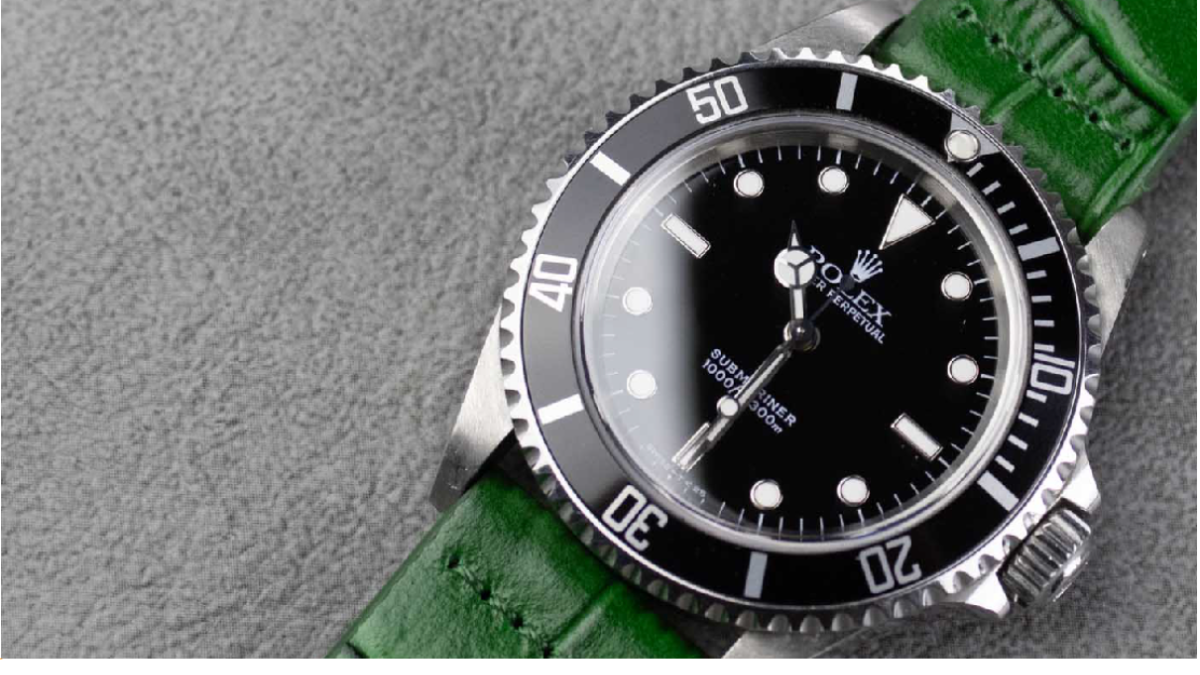
There is a moment every watch collector reaches: the watch is right, the movement is right, the case is right — but something about the overall look isn’t landing the way it should. Nine times out of ten, it’s the strap.
The factory strap that came with your watch was designed to appeal to the widest possible audience at point of sale. It’s fine. It’s not considered. And if you’re the kind of person who reads about the AP x Swatch Royal Pop collaboration before it drops, you are not someone who settles for fine.
The alligator leather watch strap is where serious collectors go when they’re ready to stop leaving the finishing touch to the manufacturer.
Why Alligator
The alligator watch strap has been the reference standard for formal and dress watches since the mid-twentieth century. Patek Philippe, Audemars Piguet, Vacheron Constantin — every maison at the top of the market ships their most important references on alligator. It’s not tradition for tradition’s sake. It’s the recognition that the texture, the structure, and the way the leather moves with wear are genuinely different from anything else available.
The distinctive scale pattern of alligator leather — the rectangular belly scales with their natural channel lines — reads immediately as something considered. On a dress watch, it elevates the entire wrist stack. On a sport watch worn in a formal context, it creates the contrast that makes the combination intentional rather than accidental.
The problem has always been access. Genuine alligator leather watch straps from established maisons start at $300-400 and go significantly higher. For a strap that contacts sweat, humidity, and daily wear — the economics have never entirely made sense.
The Embossed Alternative
The watch strap market has a well-established solution: full-grain calfskin embossed with the alligator pattern. The texture is identical — the same rectangular scale geometry, the same channel lines, the same raised surface that catches light differently at different angles. The material is full-grain calfskin — the highest leather grade available, the only grade that develops a genuine patina with wear.
This is not a compromise position. It’s the same approach used by many mid-tier Swiss brands for their standard issue straps — the distinction is in the quality of the base leather and the precision of the embossing.
The difference between a good embossed alligator strap and a poor one is entirely in the base leather. Top-grain or bonded leather embossed with an alligator pattern looks correct when new and deteriorates quickly — the embossing flattens, the leather cracks at flex points, the channel lines lose their definition. Full-grain calfskin embossed with the same pattern retains the texture indefinitely and, like all full-grain leather, develops character with wear rather than degrading.
How to Wear It
On a dress watch — black alligator embossed calfskin on a slim dress watch with gold hardware is the most formal combination available. The scale texture adds visual complexity without breaking the overall formality of the look. On a Cartier Tank, an Omega De Ville, or a dress reference from any major Swiss house — black alligator is the finishing move.
On a luxury sport watch — brown alligator embossed calfskin on a stainless sport watch creates the most considered contrast in watch collecting. The warmth of the leather against the cool of the steel, the formal texture against the sporty case — this combination works on a Royal Oak, a Nautilus silhouette, any sport watch that crosses into dress territory.
On a chronograph — dark brown or oxblood alligator embossed calfskin on a chronograph references the original straps worn on these watches in the 1960s and 1970s. Heuer Carrera, Omega Speedmaster, Breitling Navitimer — the watches that defined the chronograph category were worn on exactly this type of strap.
On a collaboration piece — the MoonSwatch, the AP x Swatch Royal Pop, any collaboration that bridges the accessible and the aspirational — an alligator embossed strap transforms the piece from a conversation starter into a considered accessory. It signals that you know what you’re doing with a watch.
The Size Question
Before ordering any strap, confirm your lug width — the gap between the watch lugs in millimetres. This is the most important measurement in watch strap buying and the one most consistently overlooked.
Common lug widths for watches that suit alligator straps:
WatchLug WidthRolex Datejust 36mm20mmOmega De Ville18mm or 20mmCartier Tank Solo17mmAP Royal Oak 37mm20mmLongines Master Collection20mmIWC Portugieser20mm or 21mmPatek Philippe Calatrava18mm or 20mmThe measurement is usually stamped on the case back. If not, measure the gap between the lugs directly with a ruler. Order the exact size — a strap 1mm too wide will not fit between the lugs.
Where to Find Quality
Alligator watch straps from CNS Watch Bands use full-grain calfskin embossed with the alligator pattern throughout — not top-grain, not bonded leather. Available in black, dark brown, warm brown, and oxblood across all standard lug widths from 16mm to 22mm including odd sizes. Short lengths available for smaller wrists. Prices from $14.95 — a fraction of the genuine alligator price with the same visual impact. Ships worldwide.
The Finishing Move
The watch is the statement. The strap is the punctuation.
A well-chosen alligator strap doesn’t announce itself. It completes the look in a way that’s noticed by people who notice things — the kind of detail that separates someone who wears watches from someone who collects them. At the price point of a quality embossed alligator strap, there is no reason to leave this detail to the manufacturer.