

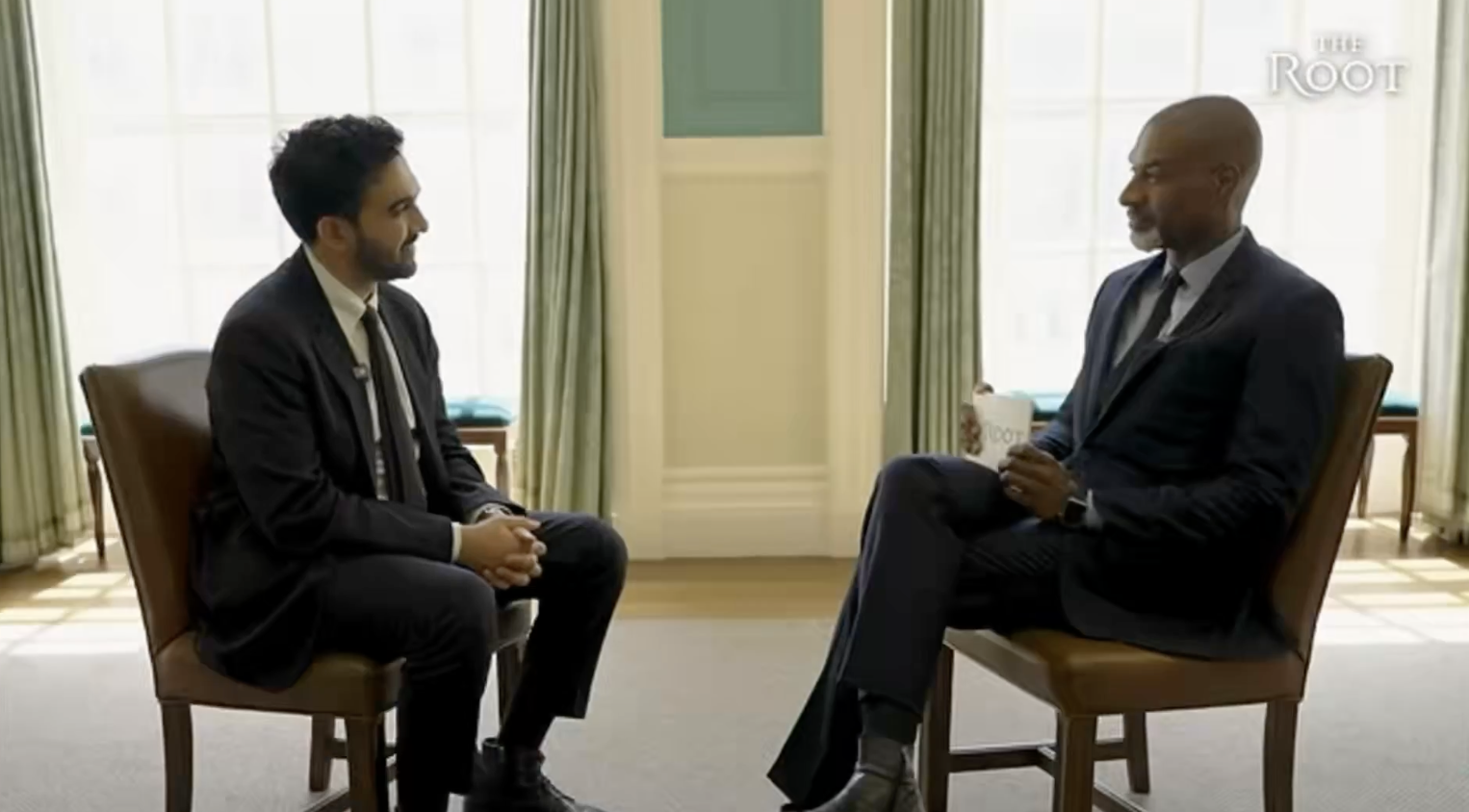
When people talk about the housing and cost-of-living crisis in New York City, it is often framed as an abstract economic figure or a debate over rent stabilization. But in a wide-ranging interview with New York Times columnist Charles Blow for The Root, New York City Mayor Zohran Mamdani put a human face on the data: the city is experiencing a massive, historic departure of Black residents.
Sitting down in the Governor’s Room at City Hall, Mamdani didn’t mince words about the structural forces pricing Black families out of the five boroughs.
“Every New Yorker experiences it, but it is not evenly experienced,” Mamdani told Blow. “For all of the conversation around fear of capital flight, there’s a real flight that has happened. We’ve lost 200,000 Black New Yorkers from New York City over the last few decades alone.”
For a city whose cultural, artistic, and political identity has been fundamentally shaped by Black movement, from the Harlem Renaissance to the birth of hip-hop in the Bronx, the numbers show a major shift in the urban landscape.
During the 20th century, millions of Black Americans moved north during the Great Migration seeking economic opportunity, safety, and cultural refuge, turning neighborhoods like Harlem, Bedford-Stuyvesant, and St. Albans into iconic cultural epicenters. Today, that historic flow has reversed.
Mamdani pointed out that between 2010 and 2019 alone, the population of Black children and teenagers in New York City plummeted by 19%. As working-class families struggle with soaring rent, child care expenses, and inflated grocery bills, many are forced to relocate to neighboring states like New Jersey, Pennsylvania, and Connecticut, or move entirely to southern metros like Atlanta, Charlotte, and Houston.
“They’re still New Yorkers. They’ll tell you they’re New Yorkers. But they haven’t been able to afford New York,” Mamdani shared, framing the exodus as an involuntary displacement rather than a simple change of scenery. “And to me, when you deliver on an affordability agenda, you also deliver on the promise of Black history being something that can continue to be written in this city, not something just that we read about.”
The conversation hit deep for Blow, who has spent years documenting this shift. In his acclaimed book and documentary South to Black Power, Blow outlined the strategic and personal reasons behind Black Americans returning to the South, highlighting how northern cities have increasingly failed to deliver on economic equity and housing security.
Mamdani’s framing confirms what many scholars and residents have observed for years: New York’s affordability crisis is effectively executing a forced reversal of the Great Migration.
One of the most interesting points raised during the discussion was the changing character of historically Black communities across New York. Without targeted economic policy and aggressive affordability measures, neighborhoods that once defined Black culture risk becoming living museums.
“That is a hollowing out of this city,” Mamdani said. “So many of the most iconic Black neighborhoods now seem more iconic for the history than what the future could hold, because of that fear of displacement.”
To combat this, the Mamdani administration has centered its platform on direct affordability interventions, focusing heavily on universal child care (such as the 2-K initiative), transit equity, public housing investments, and tenant protections designed to keep working families grounded in the neighborhoods they built.
While the challenge of reversing decades of demographic displacement is steep, Mamdani remains adamant that economic policy must treat housing and living costs as a civil rights issue.
“What good is the right to sit at a lunch counter if you can’t afford a hamburger?” Mamdani noted, echoing Dr. Martin Luther King Jr. to emphasize that civil rights and economic justice are inseparable.