

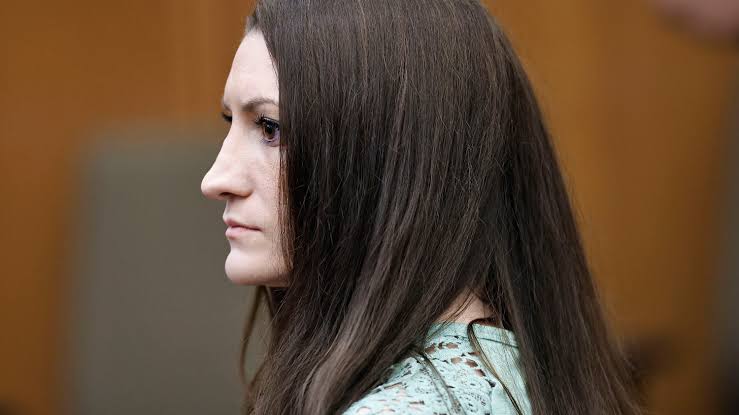
In a dramatic post-trial revelation following the high-profile Lindsay Clancy murder case, details about the jury’s inner dynamics have finally surfaced, including the demographic makeup of the panel and the identity of the single holdout who prevented an acquittal.
During an interview with Gayle King on CBS Mornings, juror Paula Devlin revealed that the sole holdout who refused to acquit Clancy was a Black man, standing as the only person of color on an otherwise all-white 12-person panel.
Speaking on CBS Mornings, Devlin broke down the demographic composition of the panel that deliberated for nearly 40 hours over seven days, describing a jury of nine women and three men ranging in age from roughly 22 to 70, many of whom had children of their own.
View on Threads
When King pressed further on the panel’s racial makeup, Devlin confirmed there was only one person of color among the twelve jurors, and that the lone holdout who blocked a unanimous verdict was that same Black man. King, taken aback by the revelation, said she needed a moment to sit with it.
The revelation sheds light on why the intense, emotionally charged trial ultimately ground to a halt, leaving 11 jurors aligned toward finding Clancy not guilty by reason of insanity, while a single voice blocked a unanimous verdict.
The trial centered on the tragic January 2023 deaths of Lindsay Clancy’s three young children, Cora, 5, Dawson, 3, and Callan, 8 months, in Duxbury, Massachusetts. Clancy, a former labor and delivery nurse, strangled her children before jumping out of a second-story window in an attempted suicide, an act that left her paralyzed.
Lead defense attorney Kevin Reddington argued that Clancy suffered a severe psychotic break brought on by unaddressed postpartum psychosis and a cocktail of prescribed psychiatric medications, maintaining that she lacked criminal responsibility and did not know right from wrong at the time of the killings.
Prosecutors, meanwhile, contended that Clancy acted with premeditation, pointing to her sending her husband out of the house to pick up medicine and dinner as proof that she intentionally engineered an isolated window of time to carry out the acts. Under Massachusetts law, once a defense presents evidence of mental irresponsibility, the burden falls on the prosecution to prove beyond a reasonable doubt that the defendant was legally sane at the time of the offense.
According to accounts from multiple jurors, including Devlin, fellow juror Nick Dargie, and foreperson Roni Carlson, 11 of the 12 jurors agreed that the prosecution failed to prove sanity beyond a reasonable doubt, concluding Clancy had “snapped” due to severe mental illness.
Carlson recalled that during deliberations, the lone holdout even admitted to having reasonable doubt regarding Clancy’s sanity, yet flatly refused to sign off on an acquittal, telling the panel, “But I’m still not going to say that she’s not guilty by reason of insanity,” even as Carlson had already begun filling out the paperwork to reflect the group’s decision.
Jurors described the holdout’s behavior as increasingly uncooperative, noting he refused to cite specific trial evidence, engaged in scrolling on his phone during discussions, and resisted participating in group evaluations of witness testimony. After the panel submitted three separate notes declaring an impasse, Plymouth County District Court Judge William Sullivan officially declared a mistrial.
With the mistrial formally recorded, Lindsay Clancy remains held at a state psychiatric facility. District Attorney Timothy J. Cruz has not yet stated whether the Commonwealth will pursue a retrial, though a status hearing has been scheduled for September 29.