
Award season is always full of unscripted moments, but the 2026 BAFTA Film Awards delivered a controversy that has sparked a massive conversation about accountability, broadcast editing, and who is prioritized when things go wrong.
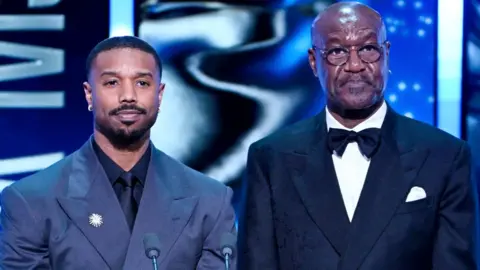
At the center of it all are two of Hollywood’s most respected actors, Michael B. Jordan and Delroy Lindo, who were subjected to a racial slur on stage. While the BBC has since issued an apology for airing the moment, the handling of the incident by both the network and BAFTA reveals a frustrating double standard.
Here is a breakdown of what exactly happened, why it is complicated, and where the institutions dropped the ball.
Delroy Lindo says him and Michael B. Jordan did “what we had to do” to continue presenting at the BAFTAs after John Davidson shouted the N-word in an involuntary tic.
— DiscussingFilm (@DiscussingFilm) February 23, 2026
He said he wishes “someone from BAFTA spoke to us afterwards.”
(Source: https://t.co/CetXlW2PDv) pic.twitter.com/QM425fPt2M
What Actually Happened on Stage?
While Jordan and Lindo were presenting the first award of the night, the n-word was yelled at them multiple times from the audience.
The individual who shouted the slur was John Davidson, a Scottish Tourette syndrome campaigner. Davidson was in attendance because I Swear, a biopic based on his life and struggles with the condition, was heavily nominated. In a twist of irony, Robert Aramayo, who played Davidson in the film, actually took home the Best Actor award that night, beating out Jordan in the exact same category.
Davidson’s condition includes coprolalia, which causes involuntary swearing or socially inappropriate remarks, especially in high-stress or public environments. Because of his disability, the conversation shouldn’t be about placing the blame solely on him. Instead, the focus has rightfully shifted to the institutions that put him in that environment, knowing the risks, and completely fumbled the aftermath.
@sh4ysgrwm it’s an unfortunate situation all around. But the ableism is unacceptable. Having these kinds of tics does not mean that we actively have it in our vocabulary. #baftas #tourettesawareness #foryoupagе #fyp ♬ original sound – shay. 🤍
The Apology That Went to the Wrong People
The first major misstep came directly from the stage. Following the outbursts, BAFTA host Alan Cumming addressed the room to explain Davidson’s condition. However, Cumming wrapped up his statement by apologizing to the crowd, saying, “We apologize if you are offended tonight.”
This is where BAFTA failed its presenters. The apology should not have been a blanket statement thrown to the general audience. It should have been directed immediately and specifically at Jordan and Lindo. They were the ones standing on stage, in front of their peers and millions of viewers, having a violent racial slur hurled at them.
Instead of centering the people actually wounded by the language, the apology centered the comfort of the room. Lindo, who remained incredibly professional during the broadcast, later addressed the fallout.
Speaking to reporters at an afterparty, Lindo noted that he and Jordan “did what we had to do” to keep the show moving, but he candidly admitted that he wished “someone from BAFTA spoke to us afterwards.”
The BBC’s Editing Hypocrisy
The second, and perhaps more glaring, issue lies with the BBC. The BAFTAs are not broadcast live; they are shown on a two-hour delay specifically so producers can edit out mistakes, dead air, or inappropriate moments.
Yet, the BBC chose to leave the n-word in the telecast.
To make matters worse, it quickly became apparent that the BBC was actively editing the show. They cut out winner Akinola Davies Jr. saying “Free Palestine” during an acceptance speech, and they censored director Paul Thomas Anderson saying the word “piss.” But a racial slur directed at two Black actors? That made the final cut.
Mixed Messaging and Missed Opportunities
The BBC eventually issued a statement apologizing for not editing the slur out, explaining that they recognized it was an involuntary tic. However, this defense is full of holes and mixed messaging.
One could argue that the BBC initially left it in because I Swear is a film about the harsh realities of Tourette’s. To edit out Davidson’s tics while actively honoring a movie about his life could be seen as hiding his reality. Plus, in the age of social media, the story would have leaked from the auditorium anyway, and the BBC likely wanted to avoid allegations of a cover-up.
But if that was their principled stance, why apologize for not editing it out after the fact? You cannot play both sides.
If the BBC truly wanted to respect Davidson’s reality while also protecting the dignity of Jordan and Lindo, the solution was incredibly simple. They could have edited the slur out of the broadcast and placed a clear, written statement at the beginning of the telecast or before the segment. A disclaimer explaining that an involuntary outburst occurred, that it was removed out of respect for the presenters, but acknowledging the reality of Tourette syndrome, would have gotten ahead of the leaks and protected everyone involved.
Instead, the BBC’s handling of the situation proved that while there is a necessary and growing understanding for people living with disabilities, there remains a glaring lack of understanding and basic care for Black talent navigating these predominantly white spaces.