

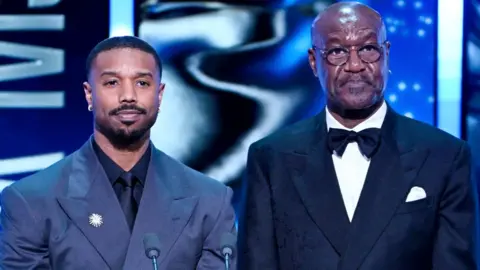
Watching Michael B. Jordan and Delroy Lindo’s expressions after they were called ni**ers on stage at this year’s BAFTA Awards shook me to my core and made me realize my naivety regarding racism. No, I wasn’t raised with a silver spoon. No, I’m not one of those “all skinfolk ain’t kinfolk” types. I’m from Southside Jamaica, Queens—Yeeerrr!—and I come from a family who worked hard to create the life we live now.
Saturday mornings consisted of Aretha, Mary J., The Winans, and Sunshine Anderson’s Heard It All Before, while I cried about having to do morning chores. Sunday was the time to be with my grandmother in church as she spread the good word, and I played the exact same beat on the drums for every song. My family’s roots are from the Deep South, a town that I don’t think is even on a map, an area where most of my family lives on the same dirt road. I was sheltered.
Of course I know about racism and the system that white supremacy has created throughout society, which continues to be upheld in many forms and by many people. The shelter that the elders in my family created was built out of love.
I can see now that they did not want to talk about racism at our gatherings as I grew up because they wanted my generation to experience life without the burden of being judged for being Black. It doesn’t mean they didn’t let us go out into the world to witness blatant racism in society.
It just meant that when we all got together, the love was strong enough to give us moments of escapism. And because I was blessed enough to have that escapism at any moment, it created a shelter. That sheltering was protection. Yet, watching two Black men on stage at this year’s BAFTA Awards having to compose themselves after being called ni**ers demolished that shelter I was in, at my big age.
The naivety I speak of is not me being blind to what my community endures. The naivety means I wasn’t angry enough. I have enough sense and empathy not to speak on the disability of John Davidson. What gobsmacked me was that, even with his disability, he had the ability to equate Blackness with being a ni**er. How ingrained racism is in society. How hate can still show up in any form.
Color me surprised upon finding out that this year’s award show operated on a two-hour delay. What was even more shocking were the reports that the broadcast had already cut out a “Free Palestine” speech given by writer Akinola Davies Jr. It is like they wanted millions of Black viewers to feel put in their place. No compassion for what that incident may trigger. What came next was the apology:
“You may have noticed some strong language in the background. This can be part of how Tourette’s syndrome shows up for some people as the film explores that experience,” Alan Cumming, the host of this year’s award show, said, per Variety. “Thanks for your understanding and helping create a respectful space for everyone.”
Having to attach that explanation to the apology was more to gain sympathy for Davidson than to acknowledge the hurt Jordan and Lindo were faced with. But that’s the thing: this is what the world expects from Black folks. Endure, give grace, show understanding. Move on from slavery, Jim Crow, the Tulsa Race Massacre, and the Tuskegee Experiment. Accept that the President of our country posted a social media image depicting our first and only Black President and his wife as gorillas, and attack DEI initiatives as if we do not earn our accomplishments on merit.
The constant restraint expected of us goes unnoticed. We are a forgiving people, we say what needs to be said, and we go about living in our joy. But that forgiveness isn’t asked of us, nor is it earned; there are those who simply believe it is required.
For me, the anger that came was not from Davidson’s involuntary outburst. It was how quickly many social media users became Tourette syndrome advocates. How quickly everyone became experts by doing quick Google searches, all out of a desire not to give Black people the space to express their frustrations. Every post was met with comments rooted not in compassion, but in an entitled demand that we shouldn’t have a moment of anger and needed to quickly move on—because everyone else matters but us.
The outrage grew because of the lack of acknowledgment and the constant debate over what that moment triggered in us. What was meant to be a celebratory moment was interrupted by an incident that reminded us all about the complex relationship Black people have with society.
The naivety protected me to this point, but the anger opened my eyes.