


Many of us first met Rhenzy Feliz as Alex Wilder, the brilliant and complicated leader of Marvel’s Runaways. It was his first real job in Hollywood, landed after just a year of auditioning, and it put him on set for six months at a time, working 12- to 14-hour days.
Feliz calls it a crash course in the energy, discipline and preparation the job demands. It also gave him some of the closest friends he still has today.
From there, Feliz kept showing up in places audiences didn’t expect. He became the voice of Camilo in Disney’s Oscar-winning Encanto, whose breakout song We Don’t Talk About Bruno climbed all the way to No. 1 on the Billboard Hot 100.

He appeared in George Clooney’s The Tender Bar and Kelly Reichardt’s The Mastermind. Then came the role that changed everything: Victor Aguilar, the unlikely heart of HBO’s The Penguin, playing opposite Colin Farrell.
Before the sets and the spotlight, there was the Winter Park Public Library. Born in New York and raised in Winter Park, Florida, Feliz grew up without cable. His love of film came from Blockbuster runs, dollar Redbox rentals and a library that let him check out 10 movies a week for free, which he watched from the moment he got home from school until his mom sent him to bed.
His grandmother, who came to the United States from the Dominican Republic in her 30s, helped raise him while his mother worked, filling his childhood with Dominican culture, good food and music that never seemed to stop.
Now, Feliz is part of the crew in David Leitch’s How to Rob a Bank. The action comedy follows a group of robbers in Pittsburgh who don’t just pull off heists. They film them, edit them and post them online, turning their crimes into a viral movement.
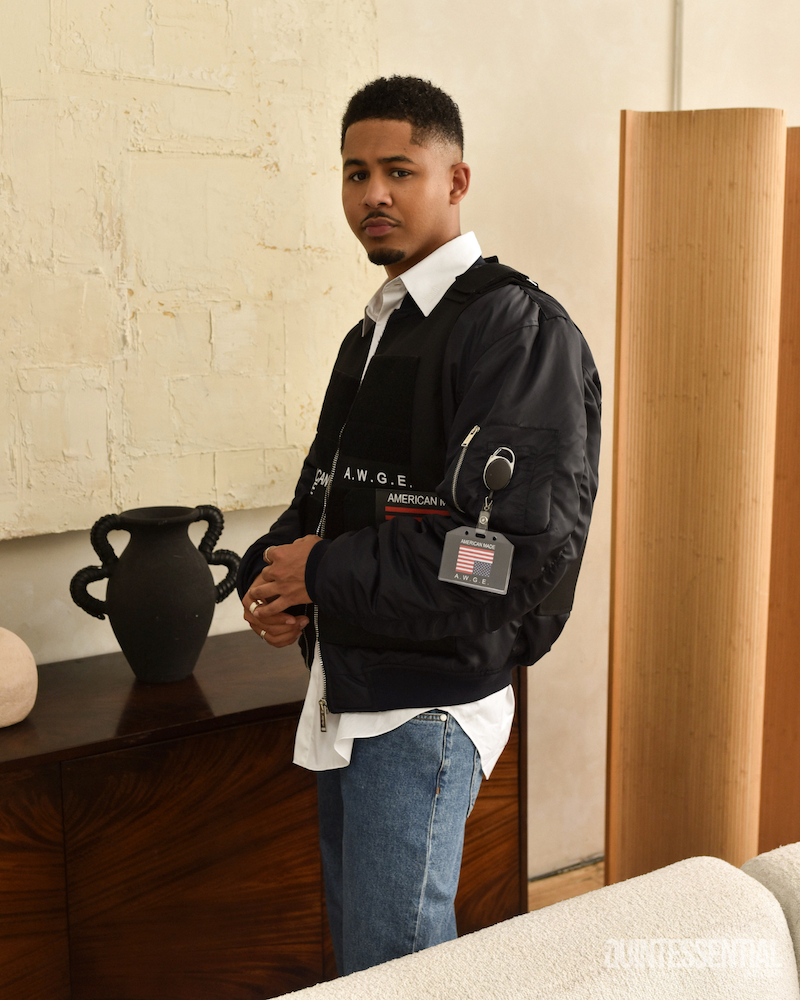
Feliz plays Hugo, known as The Rabbit, a 27-year-old wronged by the health care system who’s desperate to provide for his grandmother and family. He’s the crew’s tech mind and videographer, the one who knows how to make the world care. He stars alongside Nicholas Hoult, Zoë Kravitz, Anna Sawai, Pete Davidson and John C. Reilly.
Beneath the action and laughs, the film has something to say about class, wealth and the people society overlooks, and for Feliz, that made the project even more meaningful.
We sat down with Feliz to talk about the library that raised him, the lessons he learned on his first big set, what How to Rob a Bank says about the American dream and the dream role he’s been chasing since he was a kid.
[Interview has been edited for length and clarity]
You were born in New York and raised in Winter Park, Florida. What was your relationship with movies and storytelling growing up?
Feliz: My relationship with entertainment and storytelling growing up was mostly one that I just kind of created on my own. We grew up not as affluent or financially stable, so there wasn’t any cable around, so I didn’t really have TV to watch. For a long time, my outlet was Blockbuster. We would go rent a movie. Then when Redbox came out, dollar rentals, I would get a movie every day after school. I’d get two or three, to be honest. And then I found this little gem called the Winter Park library, and you could rent 10 movies for free every week. So I would go and rent out three, four different movies every day and go home and watch them. That took up my time from the moment I got home from school until however long I could convince my mom to let me stay up. That’s where I really got this love for films and movies. That’s where it started.

Who were the actors you looked up to?
Feliz: Growing up, my favorite actor was Will Smith. When I would go over to my cousin’s house, they had Nick at Nite, and The Fresh Prince was always on. Then he was coming out with movies like The Pursuit of Happyness. I remember watching that as a kid, and that kind of blew me away. Movies like Ali and Men in Black. I Am Legend blew my mind. Hancock. I thought Hancock was the greatest movie ever made when I was growing up. He just had this run as I was a kid. He was funny, but he could pull off the dramatic stuff too. I just found him to be incredible.
Your first big job was in the Marvel universe with Runaways. What did that experience teach you?
Feliz: That was a fun gig. That was the first time I’d ever really gotten on a set. I had just been auditioning for about a year when I got that job. Everything felt so new to me. It was the first time that I’d gotten to be on set for six months at a time, working 12, 13, 14 hours a day. So that was the first time I’d gotten to experience the energy needed over a six-month period to shoot something like that, and it taught me so much. There’s so much that I’ve done since that I wouldn’t have been able to bring my best for, not knowing the amount of rest that you need or how much time I needed to memorize certain things. It was a huge learning lesson. And I made some of the best friends I’ve ever had to this day on that set.
What drew you to How to Rob a Bank?
Feliz: Honestly, the creative involvement. David Leitch, I’ve been a fan of his for a while now. The cast is incredible. We got Nicholas Hoult. We got Zoë Kravitz. We got John C. Reilly. Growing up, I think right after Hancock, Step Brothers was the next one that jumped on my list of favorites. Pete Davidson, Anna Sawai. We got so many great actors in this film. And then pairing that together with David and the script, I was like, I’d be lucky to get on a project like this and go have fun with them for a few months. So really it was the creators behind it and the script all together.

Tell us about Hugo.
Feliz: My character, Hugo, is a 27-year-old kid living in Pittsburgh who has been slighted in his own way by the health care system. We don’t get into it too far in the movie, but I know what was happening to him. Really what he wants is to be able to provide for his grandmother and for his family, which I could seriously relate to, because my grandma was who a lot of times spent so much time around me and raised me whenever my mom couldn’t be there. He just cares so much about his family, and he feels like he’s been wronged in a way. So what does he have to lose? His family, potentially, and their status here in the United States. But also, there’s a sense of responsibility he feels to provide for the people that he loves. All that being said, he’s a fun guy who wants to get the most out of life. It’s just life’s getting the most of him at the moment.
What’s his role on the crew?
Feliz: He videotapes the bank robberies that go down. Not only does he videotape them, he edits them and uploads them, and he really is the technological side of the operation. He knows how to get something to go viral. He understands that world a little bit better than the rest of the team does. So they entrust him with what the big goal of the plan is: to get people to care, to get it online, to get people to see what we’re doing.
The film looks like an action comedy, but it has a lot to say underneath. What stood out to you?
Feliz: A lot of people might look at this film like an action comedy. There’s a whole conversation about class and wealth and the underrepresented people. When I took it all in, I maybe just wanted to do the movie even more. There’s something about our society right now where there’s a lot of people who are underrepresented, and it’s almost like they don’t have that voice. The movie gets into that struggle, and it gives this voice to the underrepresented.
Do you still believe in the American dream?
Feliz: Yeah, I do still believe in the American dream. I think there are opportunities, and that’s not to say that it isn’t easier for others, and it’s not to say that there aren’t a lot of people going through incredibly difficult times right now that look like me. I think the film gets into something really interesting, which is that you can take power into your own hands. Sometimes it can feel helpless and powerless, and that’s true. I’ve been in those situations myself where it’s like, what can I do to try and pull myself out of a certain situation? But there is light at the end of the tunnel. Not that I’m saying we should all be robbing banks, but you can take action. There’s things to be done, and I think that’s one of the bright messages of the movie.
Hugo turns the robberies into viral content. Why do you think audiences connect with that idea?
Feliz: I think that’s something interesting about our society, that it’s incredibly believable that something like that could happen. I think there’s something to the idea that people want to see the underdog win. They want to see the little guy take it to the man and get one over and win. And I think this film gives voice to that plight and to rise up against it.
David Leitch is known for big action. How demanding was the shoot?
Feliz: Physically, it was pretty demanding. David Leitch is known for making big action movies, where as the actors, you got to train a bit and put yourself in those situations as much as you can. But Pittsburgh in the summer is hot, man. If you see the film, we’re in hoodies and balaclavas and masks and gloves and sweats, and we’re out there shooting 12, 14 hours a day. It gets hot. That was physically the most demanding part. But what made it fun is the cast and getting to hang out with them all day. It was the four of us who were robbing banks: me, Anna, Nick and Pete. We had so much fun together. We got so close over those few months. I would go to set even sometimes just to watch John C. Reilly or Zoë Kravitz do their scenes. The people, they were a joy to work with. My only complaint is the Pittsburgh heat.

You grew up in the age of social media. How has that shaped you?
Feliz: It shapes the way I think all of us grew up and how we see the world around us. There’s a certain filter that people can put on their lives, and then you look back at your own life and you don’t feel as fulfilled by it, because there’s so much comparison. It’s this thief of joy. On one hand, that could be damaging to our mental health and to our psyche. But on the other hand, I think there is something positive about it. If you use it as motivation, if you see this other person was able to get these things, all of a sudden you can turn that into something positive in your life. There’s two roads you can take with that, and I think you benefit more if you take it as motivation and let it fuel you and drive you.
How do you protect your privacy when so much of your life is on camera?
Feliz: A part of my life I know is going to be public, of course, just because of what I do for a living. But the personal relationships that I have in my life, I don’t really post about those very much, and I do try to keep a certain sense of privacy. There’s just something about the way that I grew up or was raised or just the way that I was born. I like the idea that my life is mine, and that there’s certain things that you’ll have to know me to know about me. There’s something interesting or romantic about that idea, even. The things that I love and keep near and dear to my heart, they stay there. And the people who know me are allowed into that world.
How do you feel about the state of Hollywood when it comes to telling stories about people who look like you?
Feliz: I think it’s in a better place than it’s ever been. There’s so many different streaming platforms and production companies that are making stories. I do think that there is room to grow. One that comes to mind off the top of my head is a movie called Waves. Beautiful film. It’s a great example of how we can tell stories in this space and it work. It can just be a great film. I’m lucky enough to be working on something soon that I think is going to be in a similar vein in terms of high quality, great storytelling. And I find myself in a spot where I want to be telling more of those kinds of stories.
If you could return to the Marvel universe, would you revisit an old character or take on a new one?
Feliz: I’d take on a new one. There’s something exciting about jumping in on something brand new and fresh. And I’ve been thinking about a certain role for years, since I first started acting. Maybe I’m a little too old for it now, I’m not sure, but Miles Morales has always been the bucket list dream role. I’ve been in love with Spider-Man since I was a kid. I used to have his bed sheets when I was younger. I grew up on the Tobey Maguire ones, and they were the coolest things in the world to me. They ended up never making a live action while I was kicking around 19, 20 years old, but I moisturize every day. I’m keeping the skin fresh. So if there’s any world out there, we can make something happen. Maybe a slightly older version of Miles. He doesn’t have to be in high school. He can be in college, just getting out of college. So there’s options. And if we can find the right story, I’d love nothing more.

Editor-in-Chief: Eric Keith
Photographer: Owen Duckett
Stylist: Raz Martinez
Groomer: Jessica Smalls
Videographer: Lawrence Pitts
Graphic Designer: Pamela May