


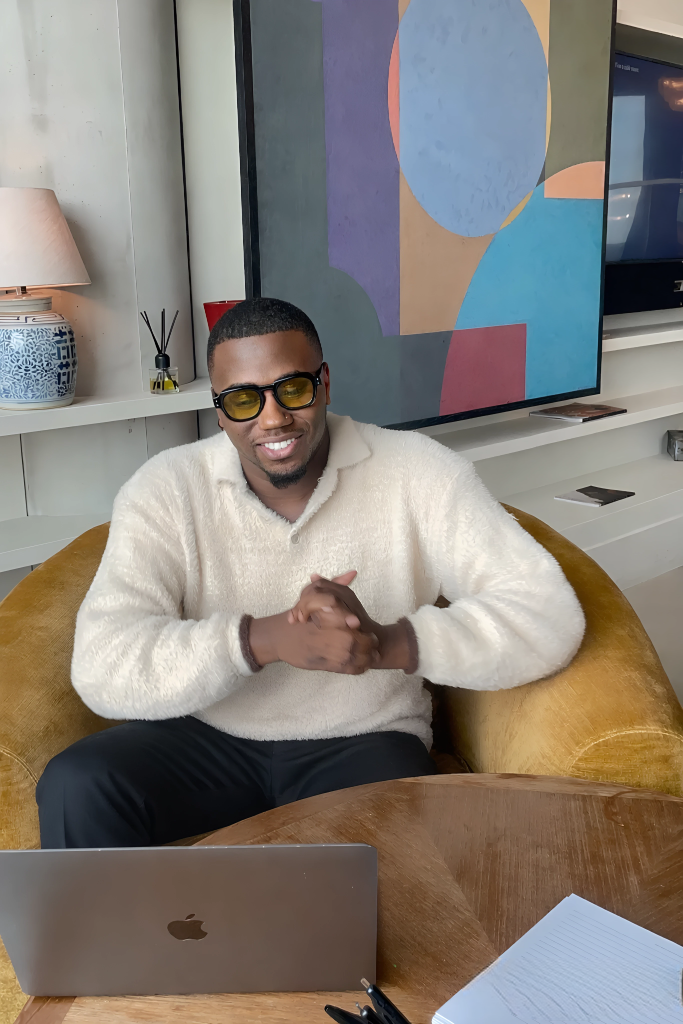
Kyle McKitty is a mobile app developer and entrepreneur who has successfully built a lucrative career in the tech industry. Hailing from Moss Side, a neighborhood in Manchester, McKitty was determined to carve out a different path for himself by focusing on technology and design.
Today, he has broken barriers as a Black, gay entrepreneur, creating a global footprint by working on tech projects for companies across the US, Europe, and Africa.
Through his mastery of digital infrastructure, McKitty has become the go-to developer for major cultural and institutional powerhouses. His impressive portfolio includes developing an app for NAESM, a pioneering HIV prevention and health organization, which provides users with direct, discreet access to trusted information, support, and care.
He launched a platform for Everyday People, a global event series that originated in New York. This app currently helps the brand manage over 100,000 event tickets worldwide while strengthening community engagement across all of its events. He has also partnered with prominent institutions like Rutgers University to build highly scalable digital assets.
For McKitty, his journey from growing up in Moss Side to building global platforms is much more than a personal success story; it serves as a powerful message to others from similar backgrounds that it is entirely possible to break the cycle, take up space, and thrive.
In our interview, McKitty discusses his intentional approach to app architecture, the biggest mistakes entrepreneurs make when building a platform, and how he is navigating the rapid boom of artificial intelligence in the tech space.
You’ve become the go to developer for major cultural and institutional powerhouses like Rutgers University and Everyday People. When clients of that magnitude approach you, what is your specific process for taking their initial vision and translating it into a fully scalable, successful app?
When an institution like Rutgers University or a cultural brand like Everyday People approaches me, I do not start with code; I start with clarity.
My first phase is architectural discovery. I interrogate the vision, the user journey, the commercial objective, and the long-term roadmap. Most clients initially describe features, and I translate that into systems. What problem are we solving, what behaviour are we encouraging, and what does success look like in three to five years.
Second is infrastructure design. I build with scalability from day one, cloud architecture, modular backend systems, clean API layers, and payment and authentication flows that can handle serious growth. I design as if the product is going to succeed, not as if it is experimental.
Third is controlled iteration. I launch lean but intentional, then optimise through data. Real users tell you what matters. My job is to interpret that signal and evolve the product without breaking the core architecture.
The result is not just an app, it is a digital asset that can scale institutionally and commercially.
You’ve had massive financial offers on the table for your creations in the past. What is the biggest lesson you’ve learned about knowing your worth as a creator, and how does that influence the projects you choose to take on today?
The biggest lesson I learned is that valuation and value are not the same thing.
Early on, it is easy to be flattered by large offers. But I realised that if you build something with long-term infrastructure, recurring revenue potential, and cultural relevance, you are not selling code, you are selling leverage.
Knowing my worth means I now evaluate projects based on alignment, impact, and scalability. Does this platform solve a meaningful problem, does it have the potential to grow, and is the leadership team serious about execution.
I do not chase quick paydays anymore. I build systems that compound.
What is the most common mistake you see brands or entrepreneurs make when they decide they want to build an app, and how do you guide them toward a better solution?
The biggest mistake is thinking an app is the business.
An app is a distribution channel. It is a delivery mechanism. It is not a strategy.
Many founders focus on features instead of user psychology and monetisation architecture. They want booking systems, push notifications, loyalty points, but they have not defined the revenue loop or retention model.
I guide them back to fundamentals. Who is the user, what is the core behaviour, how do we retain them, and where is the revenue embedded in the journey. Sometimes the right answer is not even an app yet; it might be optimising web infrastructure or validating demand first.
Good technology amplifies good strategy. It cannot replace it.
AI is completely disrupting the tech industry right now. As an app creator, how are you currently leveraging AI to build better, faster, and smarter products for your clients?
AI is now part of my development stack, not a novelty feature.
I use AI-assisted coding tools to accelerate prototyping and reduce development cycles, which allows me to focus more on architecture and optimisation. I also integrate AI-driven features where they create genuine value, intelligent search, predictive behaviour analysis, automated content categorisation, and smart customer support flows.
More importantly, I use AI for data interpretation. Once a platform scales, the real advantage is understanding behaviour patterns. AI allows us to identify churn risks, purchasing trends, and engagement spikes far faster than traditional manual analysis.
The key is practical implementation, not hype.
For business owners who are intimidated by the rapid pace of AI advancement, what is one practical way they should be looking to integrate it into their digital infrastructure today?
Start internally, not publicly.
Before building flashy AI features into your product, use AI to optimise your backend operations. Automate customer service triage. Use AI for reporting summaries. Implement predictive analytics for sales forecasting.
If you save ten hours a week in operations, that alone changes your margin profile.
AI should increase efficiency first, then enhance experience.
Will AI eventually replace the need for traditional app developers, or does it just change the skill set required? Where do you see the industry five years from now?
AI will not replace high-level developers; it will replace average execution.
The real value will shift toward systems architects, product strategists, and engineers who understand infrastructure, security, scalability, and integration. Anyone can generate snippets of code now. Very few can design resilient digital ecosystems.
Five years from now, I see fewer pure coders and more hybrid technologists who combine engineering, data science, and commercial strategy. The barrier to entry lowers, but the bar for excellence rises.
You have successfully navigated the tech space, breaking barriers as a Black, gay entrepreneur to build a highly lucrative career. What mindset shift did you have to make early on to ensure you were taken seriously in rooms that were not always designed for you?
The mindset shift was moving from proving myself to positioning myself.
Early on, I felt I had to overperform to justify my presence. Eventually, I realised credibility comes from clarity and competence, not overexertion.
I mastered my craft to the point where my work spoke before I did. I learned to articulate value in commercial terms, not emotional ones. When you speak in numbers, scalability, retention, and revenue impact, rooms listen differently.
Confidence backed by execution is difficult to dismiss.
When people look at the apps you’ve built and the clients you’ve partnered with, what is the signature Kyle McKitty touch they are experiencing?
Intentional architecture.
Every product I build has commercial logic embedded into the user journey. Clean interface, frictionless onboarding, scalable backend systems, and revenue pathways designed from day one.
I build platforms that feel simple on the surface but are strategically layered underneath. That balance of elegance and infrastructure is my signature.