

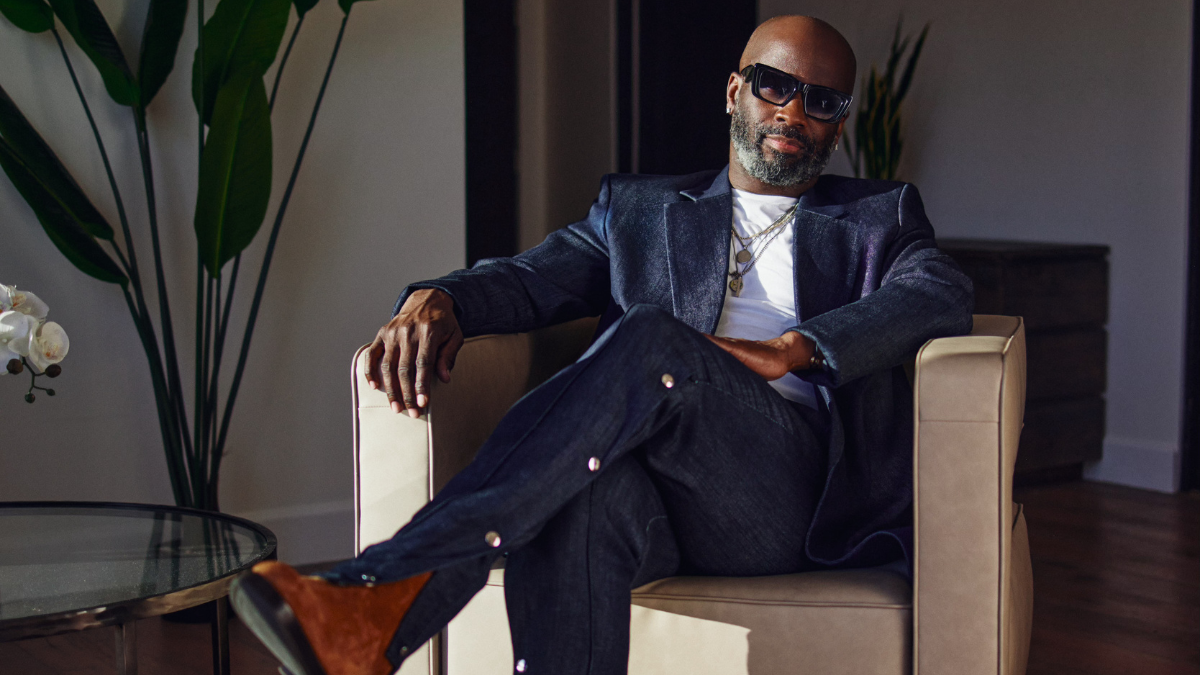
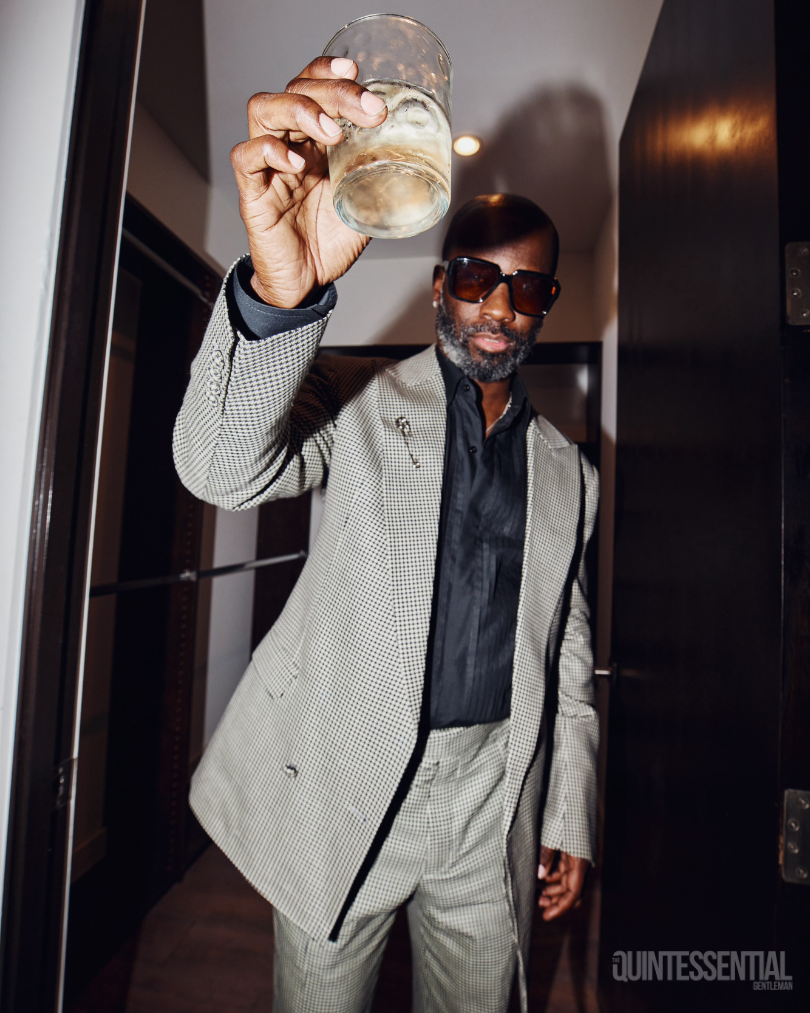
The room was quiet in the late afternoon as Bryan-Michael Cox stepped into position for a portrait. It was mid-October in Los Angeles, California, just two days after D’Angelo’s passing, and everyone moved with the focus of a team trying to get everything just right.
Lighting was tested, styling refined, and angles adjusted. There was a stillness to the moment even as music played from a tablet nearby.
Nicki Minaj’s Super Bass came through the speakers, bright and upbeat but not quite in tune with the mood. Cox held his pose for a few frames before easing out of it.
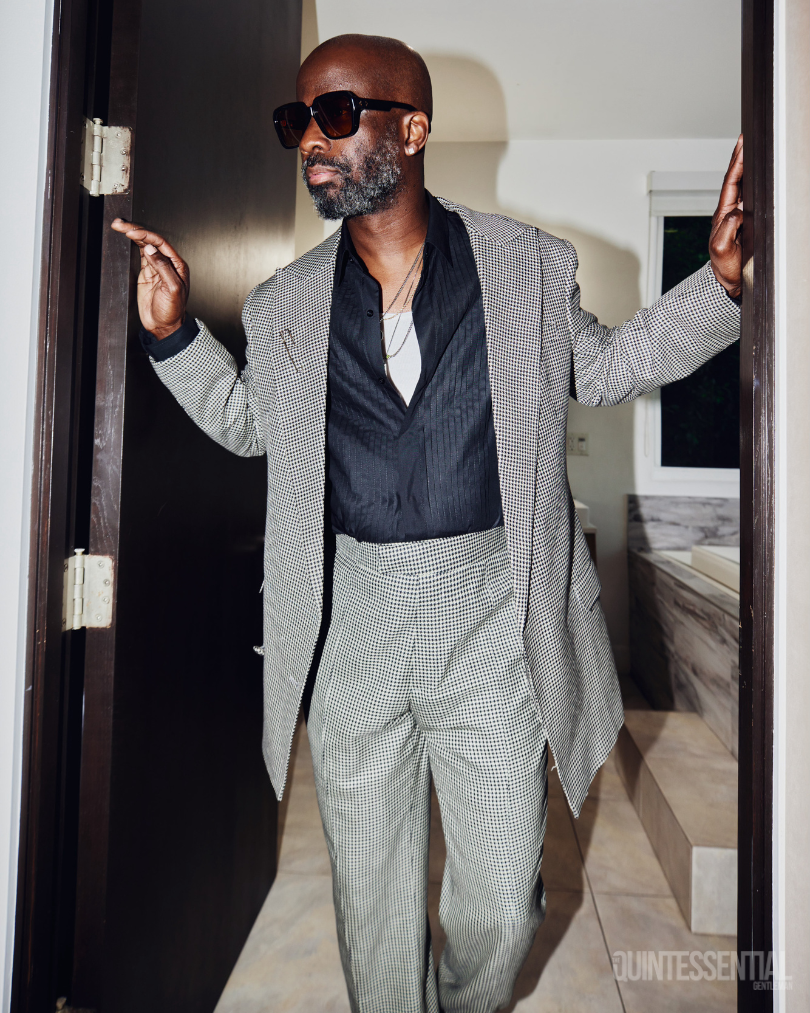
Look: House of Gray | Shoes: Jimmy Choo
He walked over to the tablet, scrolled for a moment, and made a change. Within seconds, D’Angelo’s Brown Sugar poured out of the speakers, filling the space. The shift was immediate. The atmosphere settled into something warmer, calmer, and more grounded.
Cox nodded along, found the groove, and stepped back into place. “There we go,” he said quietly. The moment captured something essential about him.
For more than two decades, Cox has shaped the sound of modern R&B by doing precisely this—reading the room, trusting his ear, leading with intention.
“When I think back on the past 20-plus years, it’s really gratitude,” he says. “When I was younger, I didn’t have a plan B. I’ve always wanted to be a songwriter and music producer.”
It may not be the sentiment most expect from someone with his catalog and cache, yet for Cox, gratitude sits at the center of everything.
It’s a grounded perspective from someone who was recently named No. 2 on Billboard’s Top Producers of the 21st Century list for Hot R&B and Hip-Hop Songs. Not to mention his record-setting run for the longest consecutive streak on the Billboard Hot 100 by any producer or songwriter, surpassing The Beatles.
As if these milestones weren’t enough, Cox also ranks among Billboard’s Top 25 Hot 100 Producers of All Time.
He is responsible for some of the most culturally resonant records of the last 25 years; songs that didn’t just top charts but shaped the emotional landscape for multiple generations. But Cox got his start in much humbler circumstances.
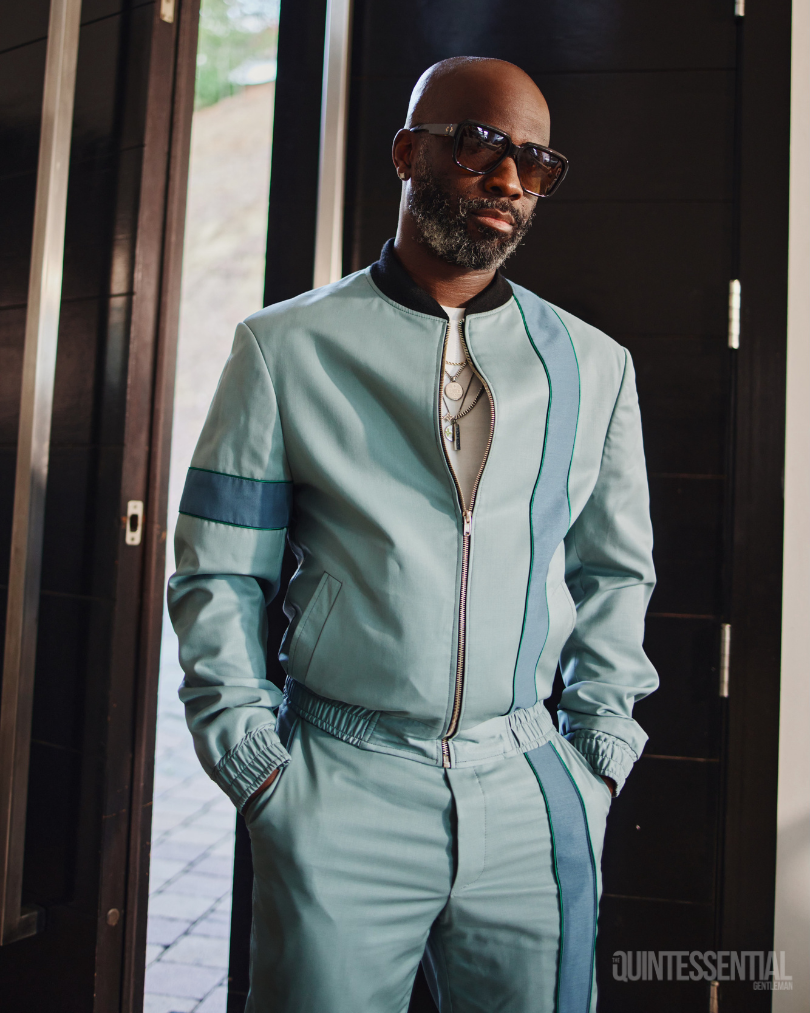
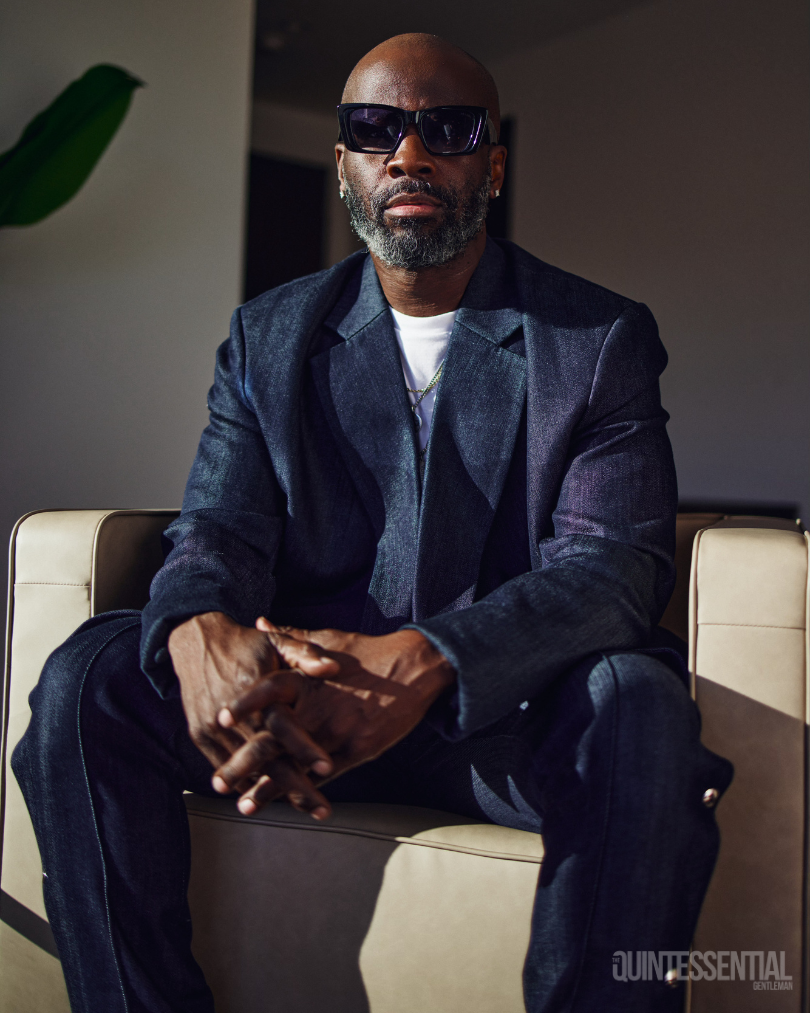
Look: House of Gray | Shoes: CL Shoes
Growing up in Houston, Texas, he developed a musician’s ear long before he entered a recording studio.
Choir rehearsals, orchestra classes, and music theory worksheets made sense to him in ways they didn’t for most kids his age. Those early lessons in harmonic structure and melodic discipline would later become foundational pillars of his signature sound.
But the true catalyst came through friendship and connection, a throughline that has remained ever-present throughout Cox’s career.
As a teenager, he spent his days around LaTavia Roberson, LaToya Luckett, Kelly Rowland, and Beyoncé Knowles, four young girls finding their voice as a group then known as Destiny.
They invited him into one of their earliest sessions, where Cox found himself arranging harmonies with a confidence he didn’t know he had.
“I was giving them notes and giving them riffs… and it was coming out better than I even thought I could imagine it,” he recalls. “I was like, ‘Oh no, this is my destiny. Being a music producer is my destiny.’”
That clarity and sense of purpose soon pushed him toward Atlanta, a city quickly becoming the nucleus of Black music and culture.
Cox began writing for Jagged Edge, pouring himself into early demos that carried his unmistakable touch. The group was affiliated with So So Def, Jermaine Dupri’s publishing company, and when they brought Cox’s demos to him, Dupri listened keenly.

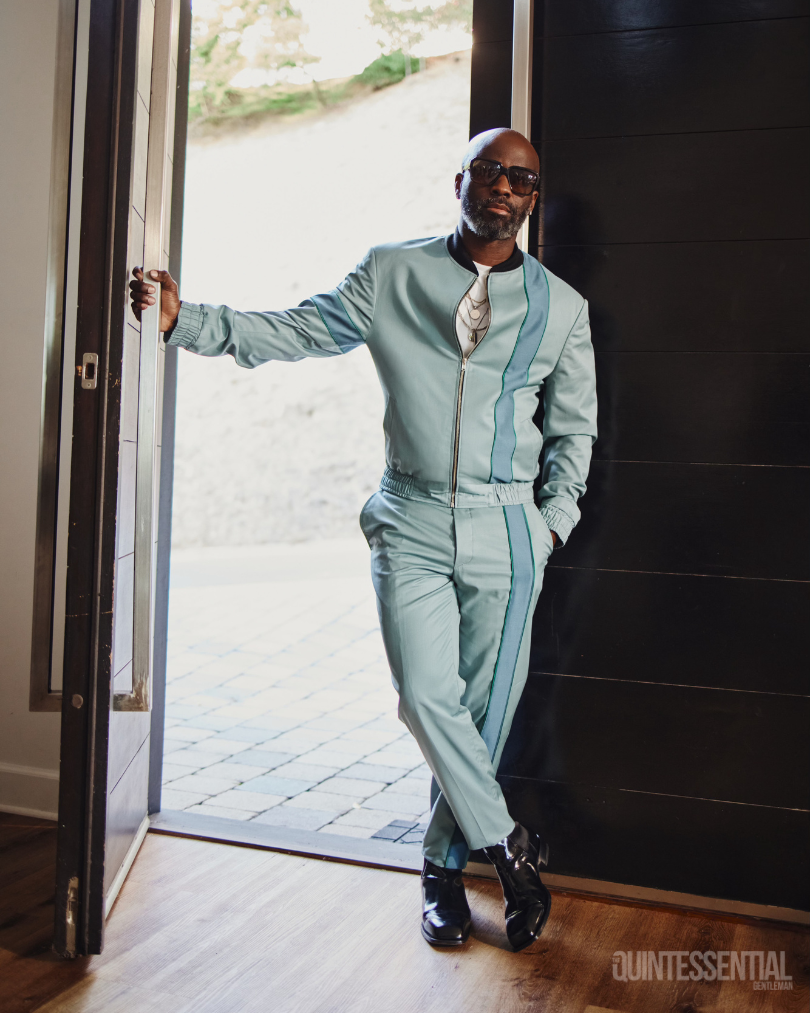
Look: House of Gray | Shoes: Jimmy Choo
Cox’s golden touch stood out immediately. Dupri asked to meet the young producer behind the demos and invited Cox to help finish the album. That moment marked the beginning of one of the most essential creative partnerships of his and Cox’s, and music history.
Soon, Cox was working alongside both Dupri and Johntá Austin, forming a trio that quietly redesigned the architecture of the genre.
“Bryan is the musical partner that everyone needs. The fact that I know he has so much music knowledge and continues to download himself, removes the ceiling on my creative process,” Dupri said
Cox’s harmonic choices became a recognizable signature: warm keys, stacked harmonies, minor lifts that cracked open emotional space, melodies that bent gently toward yearning.
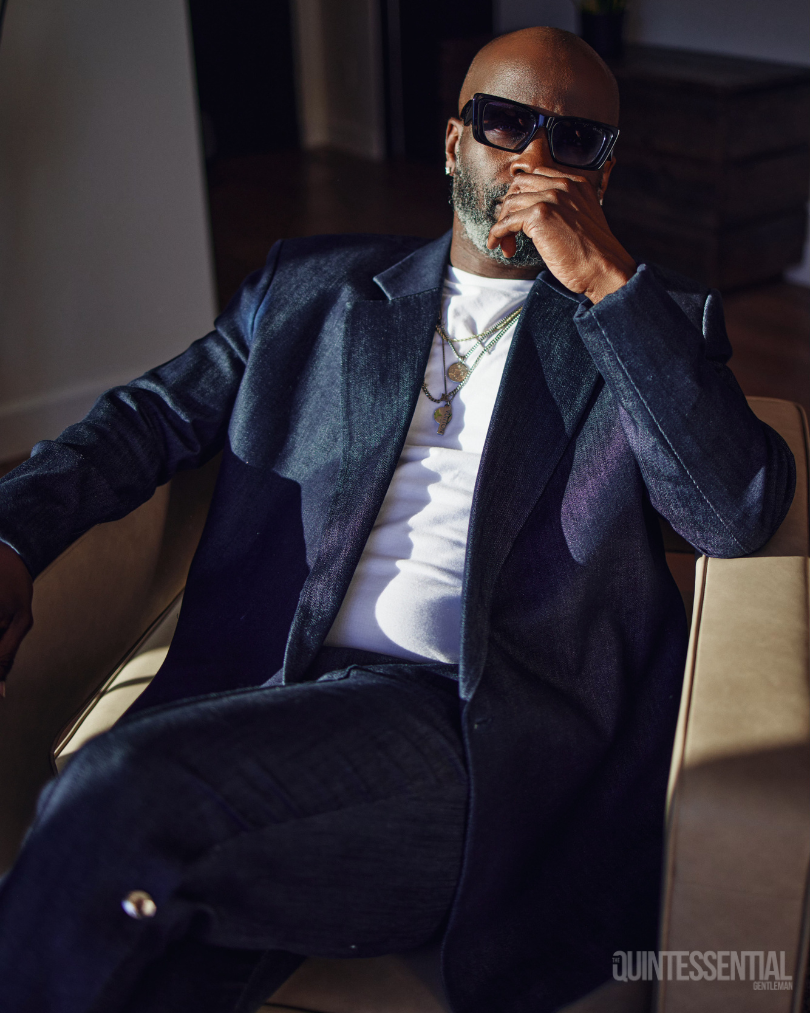
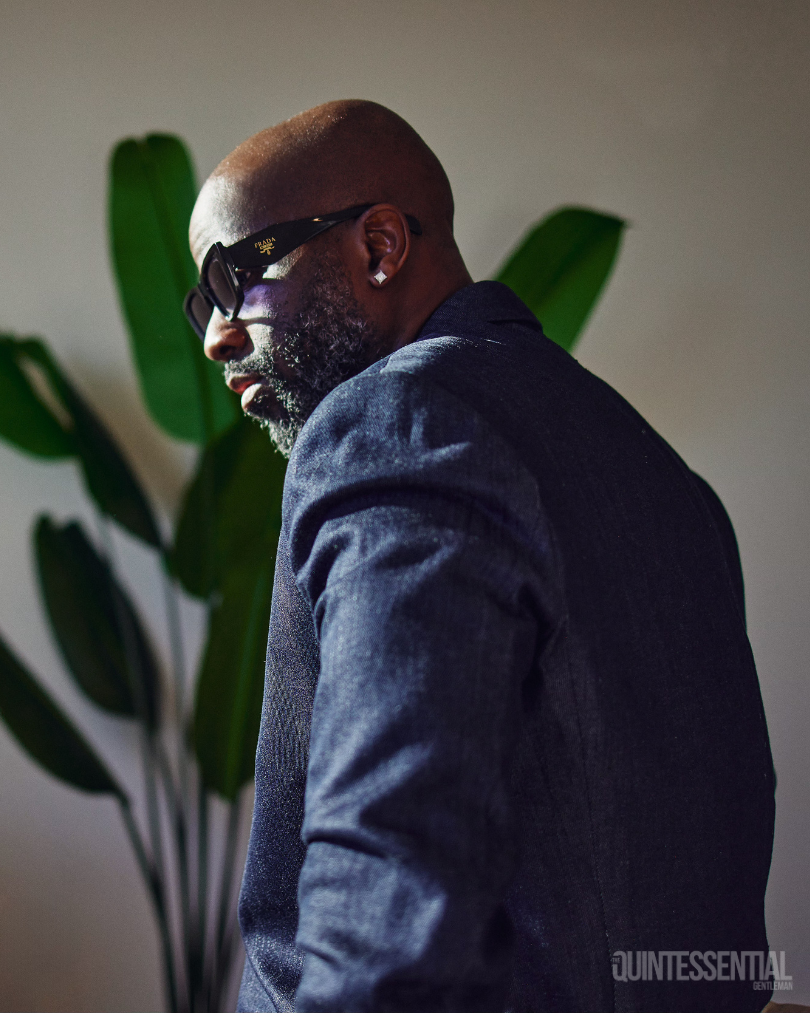
Look: House of Gray | Shoes: Jimmy Choo
His progressions invited singers to confess rather than perform. His sound was clean but full-bodied. Vulnerable but intentional. That character shaped the foundation of his work with artists throughout the late 90s and 2000s, creating records that felt lived-in, honest, and focused.
Jagged Edge’s early music carried that texture, the analog saturation, and the grounded vocal stacks.
Monica’s records held that steady resolve. Trey Songz’s formative catalog leaned on Cox’s melodic templates as a launching pad for a new wave of male R&B. Groups like Day26 built their identity on his modern mix of classic soulfulness and contemporary edge.
His fingerprints were everywhere, and although his philosophy about sound continued to evolve, his creativity was grounded in the same principles that defined his earliest work.
The pivotal moment of Cox’s early career, however, came in 2004 with Usher’s Confessions. The album wasn’t just a hit; it was an event. It shaped public conversation and shifted the lexicon for men in R&B. It became the north star for an entire generation of artists.

Cox co-wrote and produced Burn, one of the most enduring ballads of the 2000s. The record was built on simplicity: a gentle chord pattern, a spacious arrangement, and an emotional honesty that cut through the noise of pop music at the time.
He had already worked with Usher on U Got It Bad, laying the groundwork for the storytelling that would define Usher’s most iconic era. But Confessions elevated the stakes.
The album became one of the best-selling R&B albums of all time. At the center of its success was Cox, steady, quiet, and surgical as ever.
His work with Mariah Carey expanded his canvas and his reputation as a hitmaker. Cox helped craft hits like Shake It Off and Don’t Forget About Us, mixing pop precision with R&B sincerity. His production gave her space to float vocally without sacrificing the integrity of the record.
But perhaps the crown jewel of his catalog came through his partnership with Mary J. Blige. When the final mix of Be Without You arrived in the studio, Cox felt something unmistakable. He remembers how still the room became, how the energy shifted.
“At the end of the song, you’re gonna hear a pin drop,” he says. “Everybody was just quiet. And Akon says, ‘Yo, that’s the best shit I ever heard in my life.’”
Before the critical or commercial success, Cox knew that they had captured lightning in a bottle. “I was like, ‘Oh yeah, I’m going to the bank and the Grammys,’” he says humorously.
And he was right. The song set new records, dominating the R&B charts for 15 consecutive weeks. It won two Grammys and was recently named the greatest R&B song of all time by Billboard.
Inside industry circles, Cox is revered.
His instinct extends beyond traditional R&B. Cox was in the room when T-Pain performed I’m Sprung for Jive Records. After the performance, then-chairman Barry Weiss asked whether they should sign him.
Cox didn’t hesitate. “I was like, ‘Barry, if you don’t sign this kid, you guys are crazy,’” he recalls.
That signing sparked one of the most influential shifts in 21st-century music. Auto-tune went from an underground tool to a cultural phenomenon. Pop, hip-hop, and R&B were all changed forever, and Cox helped trigger the moment.
The industry was evolving fast, and he could hear the future forming in real time. But even as sounds shifted and technology pushed boundaries, he never lost touch with the elements that first inspired him.
He reminisces on the way older records carried a thickness and layering that defined the R&B sound of his more foundational eras, providing early Jagged Edge and Ideal tracks with a familiar texture.
“The sound of tape was special,” he says. “You could hear the warmth… the depth of whatever the sounds are.” He hears echoes of that richness in D’Angelo’s Black Messiah and Daft Punk’s Random Access Memories, two modern testaments to classic craftsmanship.
Longevity in music is difficult. Longevity with relevance is rare. Longevity with influence is almost impossible.
Cox has done all three, and then some. His philosophy? It’s simple. Stay low and keep firing. That approach has kept him rooted for 25 years. It has allowed his catalog to age gracefully, positioning him as a bridge between eras, generations, and styles.
Illustrate New Ideas, his label and publishing company in partnership with BMG, is cultivating new voices with the same care he brought to the artists of his early career.
Singers like Sierra Flowers and Bryce Green are developing under his mentorship. His artist, Jack Freeman, is gaining momentum with his recent single, MVP, featuring Bun B.
Ladies Love R&B, his Atlanta-based event series, has grown into a cultural movement, a lively, communal celebration of the genre that will soon span multiple cities through a touring partnership with Live Nation.
Although Cox holds a nostalgic, almost romantic, appreciation for a genre and industry that he has largely helped shape, he is realistic about what the future holds for the craft he holds so dearly.
“You can’t stop it… AI is here,” he says. His perspective isn’t alarmist; it’s protective. “Use it as a tool, but don’t let it do all the work for you. It’s soulless. There should be some regulation on it. We should be able to protect our images, protect our intellectual properties, our face, our hands, our sound.”
His advice to emerging artists is grounded in that same protective instinct. “Read the contract. Even if you don’t understand it. Ask questions. Ninety percent of people who sign contracts don’t really know what’s in it,” he warns.
He speaks like someone who has seen too many promising artists fall prey to unsavory practices. Someone determined to help others avoid those traps. With time, his outlook has widened. The lessons and longevity have cultivated a more nuanced understanding of what truly matters, expanding his definition of success.
“Success to me now is watching my son grow up and being a major part of his life,” he says. This perspective also shows up in how he gives back.
He funds a scholarship at Kinder High School for the Performing and Visual Arts in Houston, and he’s partnered with HBCU Week to help build a dedicated scholarship program.
“I went to Clark, and I went to Texas Southern, and I’m a child of HBCUs,” he says. “My mom and my father went to Bethune-Cookman, all my family went to FAMU. HBCU is in my blood. I’m very passionate about paying it forward.”
That sense of lineage and responsibility deepened with the passing of D’Angelo, an artist whose influence Cox feels deeply. Not just musically, but personally. “It’s about somebody being the fabric of your life… who actually helped define who I became as a man,” he says.
He’s aware of the timing and the weight of the moment. Just two days after D’Angelo’s passing, he found himself on set, guiding the room’s energy by cueing up Brown Sugar.
It was more than just a tribute or homage. Instead, it was a way of bringing a giant’s spirit back into the space.
Cox thinks carefully about legacy, not as an ego-driven pursuit but as stewardship. He knows the influence he wields and does so with consideration. He feels the responsibility of being part of the continuum that shaped him and thus lives and breathes through him.
“I want to be a person that actually was a forefather and a continual supporter of the advancement of contemporary R&B,” he asserts. He already is. The producer. The hitmaker. The architect of an era.
And his blueprint for the next one is already underway. Check out the full interview.
Editor-in-Chief/Art Director: Eric Keith
Photographer: Antar H
Stylist: Ron Jeffries
Groomer: Keyocsha Brown
Videographer: Leef Parks
Graphic Designer: Pamela May