


Price indices work off a basket: Pick a fixed list of goods, then track what that list costs over time. The Consumer Price Index does this for a whole economy. To create a similar index for the first 90 days of a company’s life, Brex examined internal data to determine what startups purchase using their Brex credit card in those first few months.
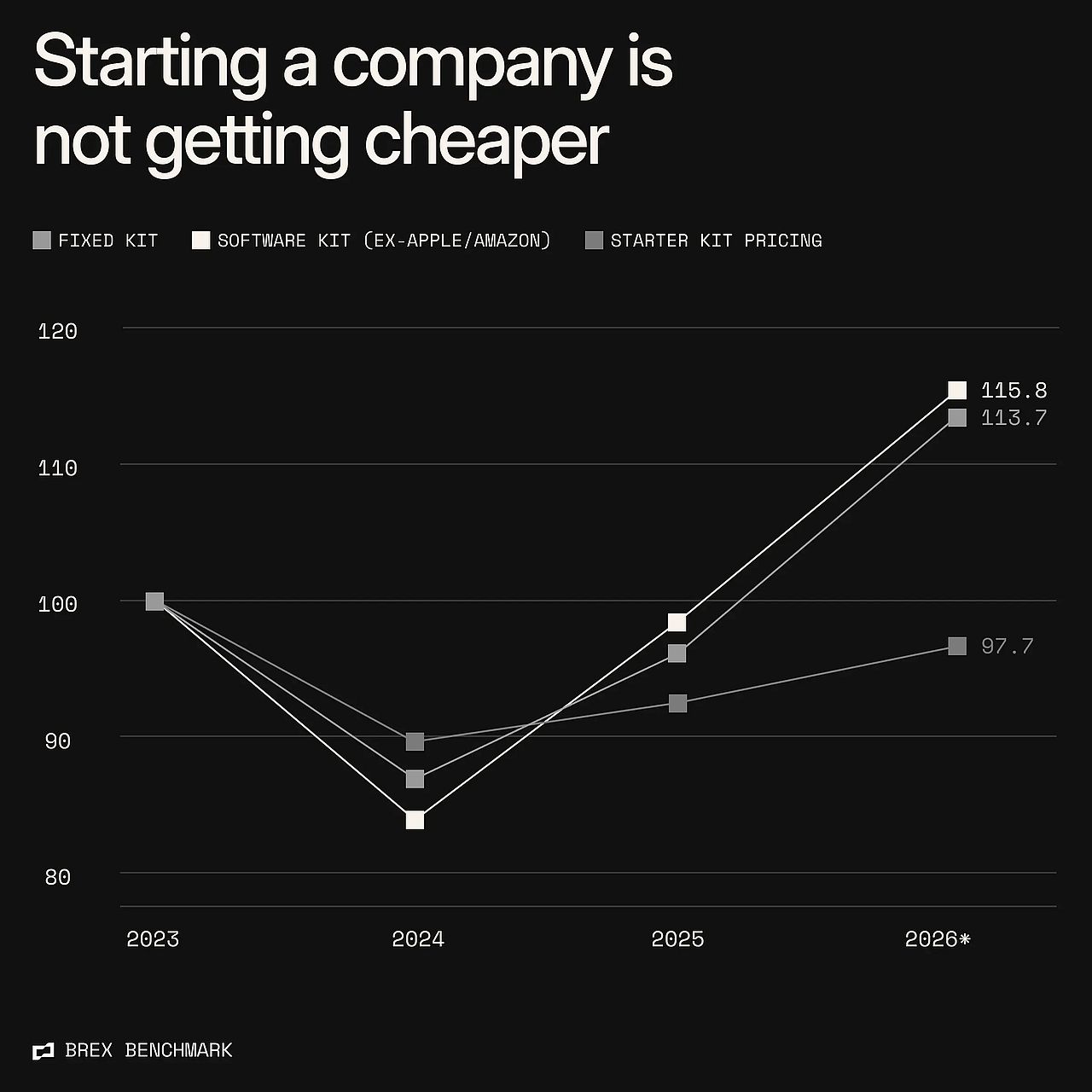
Call it the Startup Starter Kit, or “the kit”: the set of software and hardware that at least 1 in 10 brand-new companies in this dataset buys, priced the same way every year.
This is the first print of what will become an annual index, and it puts the kit at $4,417 — up 14% from what the same list cost a company founded in 2023. Tool for tool, starting a company is getting more expensive. What founders are doing about it, and which AI tool now shows up before almost anything else on a new company’s card, is the rest of this piece.
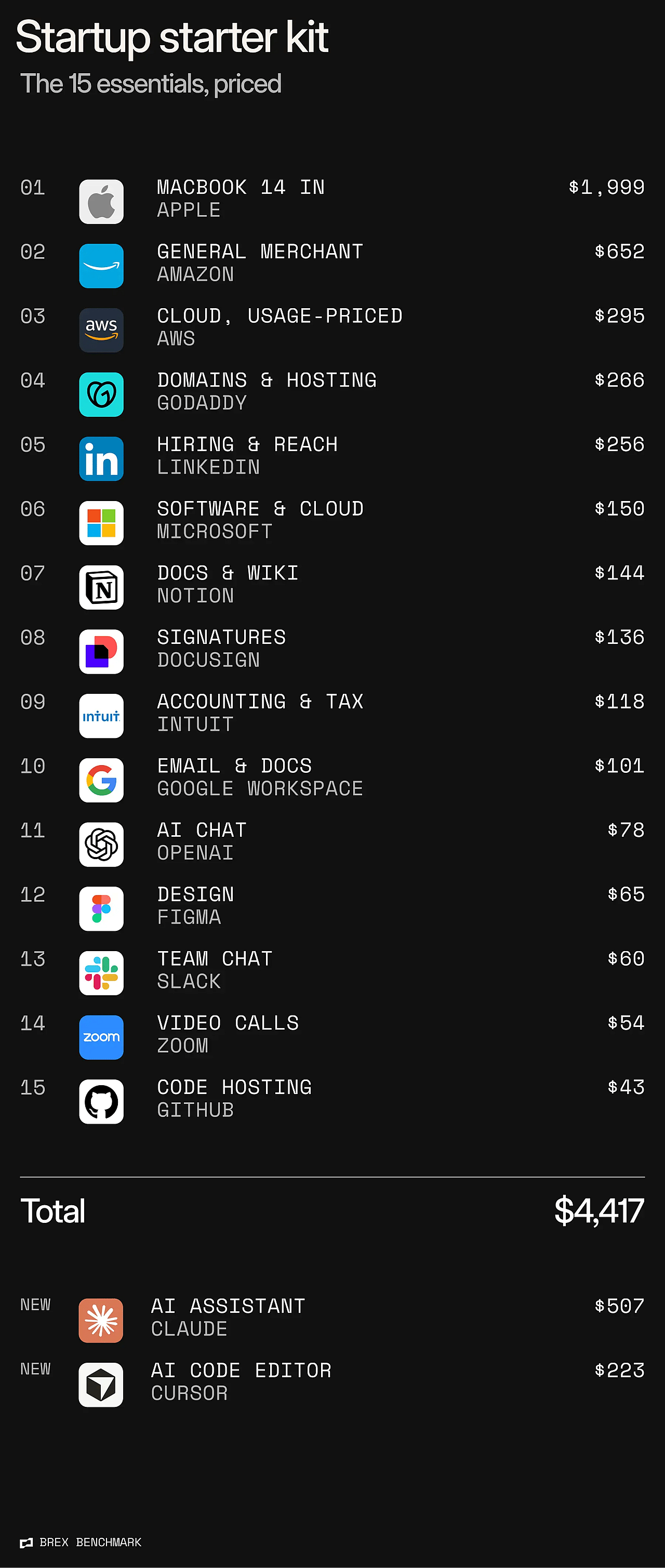
The fixed 15
New companies buy wildly different things — a biotech’s first 90 days looks nothing like a consumer app’s. Strip away the differences, though, and a small core shows up almost everywhere.
Finding that core is pretty straightforward. Here, researchers ranked every merchant by how many new companies buy from it in their first 90 days, excluded travel and meals, and set the bar at 1 in 10. If a merchant clears that bar in a given year, it becomes part of the kit for that year.
Fifteen merchants clear that bar every year from 2023 through 2025, without exception: Google Workspace, Amazon, OpenAI, Slack, Apple, LinkedIn, GitHub, Zoom, AWS, Intuit, GoDaddy, DocuSign, Microsoft, Figma, and Notion. Cursor and Claude joined the over 10% club after 2023.
The tools a company reaches for in its first three months have barely changed, even as everything else about how startups spend has been rewritten.
The cost of the kit
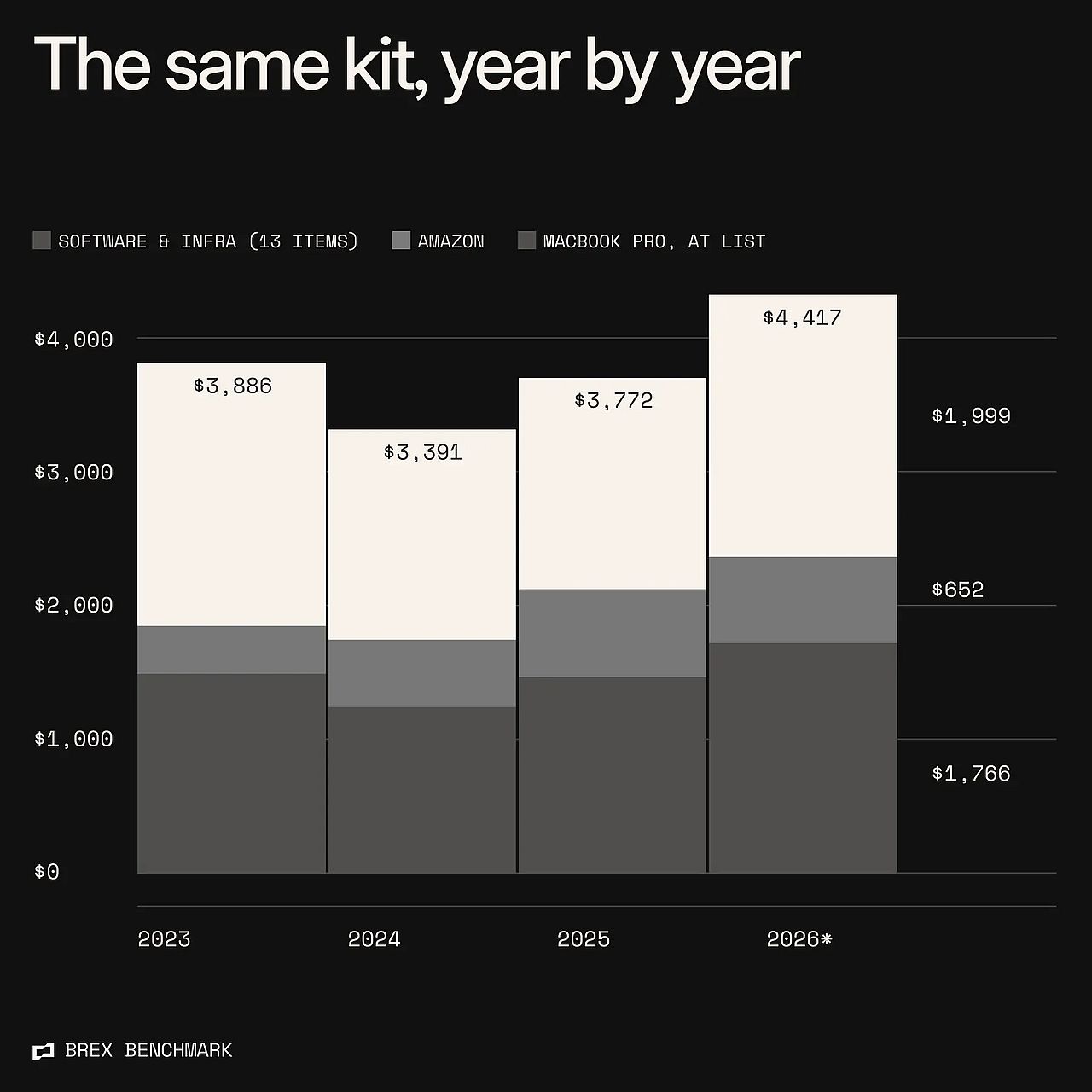
The fixed kit cost $3,886 for the 2023 cohort, $3,391 for 2024, $3,772 for 2025, and $4,417 for 2026: a 13% dip, a near-full recovery, then a 17% jump that leaves the kit 14% above where it started. Across the three complete cohorts (2023–2025) the kit is roughly flat.
The dip is Apple’s own pricing: It cut the base MacBook Pro from $1,999 to $1,599 with the M3 generation, and by the 2026 print, the price is back to $1,999 in the M5 era. Amazon contributes about half of the dollar rise, and it’s the least clean line in the kit: A company’s Amazon charges cover everything from software to office chairs, so its median blends purchases the other 14 items don’t. Strip Apple and Amazon out entirely, and the pure software-and-infrastructure kit still went from $1,525 to $1,766, up 16%.
What got expensive, what got cheaper
Inside the fixed kit, infrastructure and back office got pricier. AWS’s median rose from $186 to $295 — an understatement, since free credits burn before the card is ever charged. Microsoft went from $68 to $150, Intuit from $70 to $118, Google Workspace from $72 to $101.
The old collaboration stack deflated underneath. Figma’s median fell from $144 to $65 against a $16-a-seat list price. Slack fell from $88 to $60, Zoom from $93 to $54. GitHub held closest to flat of anything in the kit, moving a few dollars a year against its $4 seat. The discounts are real, and they come nowhere near offsetting the increases around them.
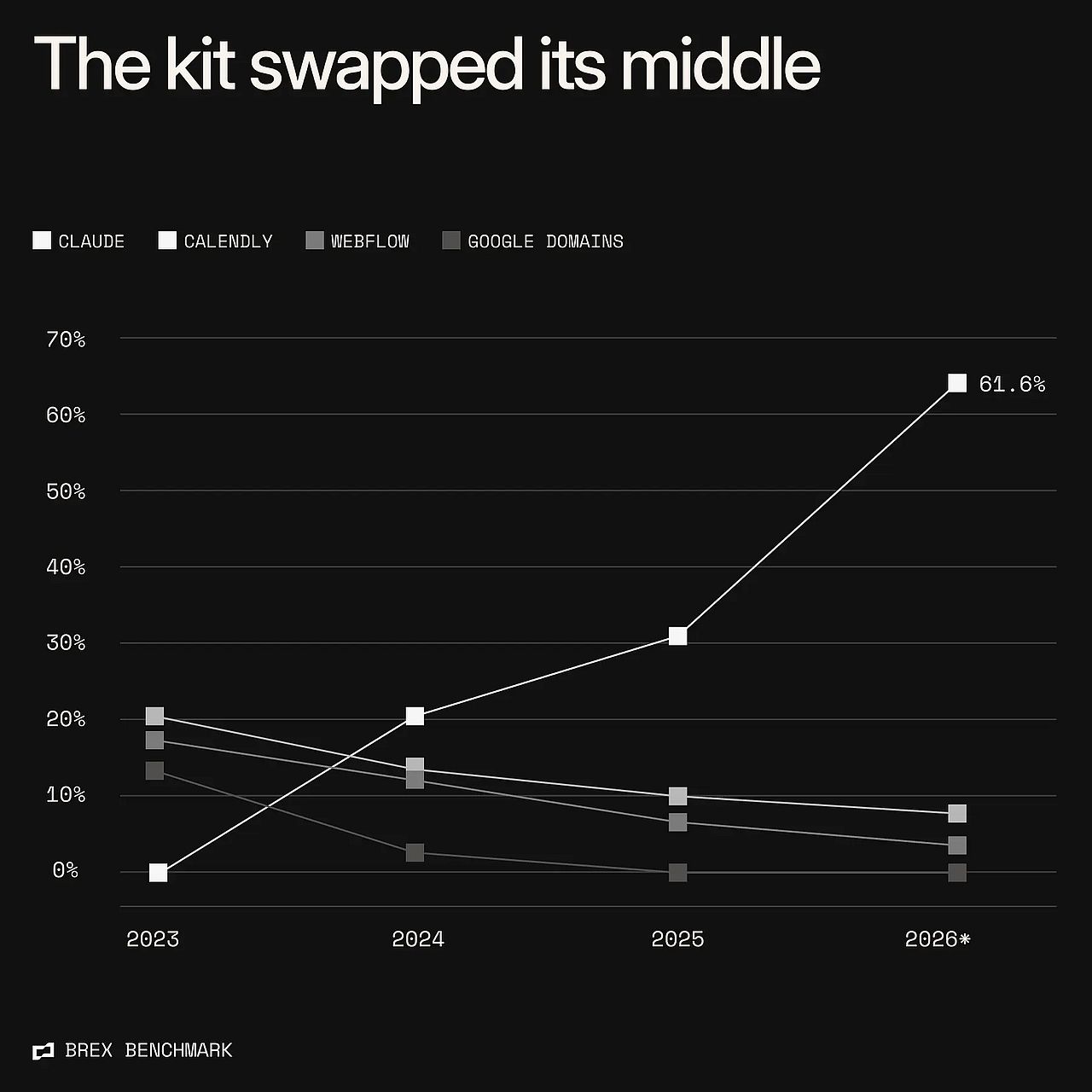
Then there’s AI, which sits almost entirely outside the fixed 15. OpenAI, the one AI merchant already in the 2023 kit, holds steady around $80. Claude went from a rounding error in 2023 to a purchase made by 62% of the 2026 cohort — the most-adopted item in that year’s kit, ahead of Google Workspace at 41%. Its median buyer spends $507 in the first 90 days, against a $20-a-month Pro plan and a Max plan starting at $100: The typical new company is on the top tier, or buying several seats. Cursor’s median buyer went from $40 in 2023 to $223 in 2026. Both are line items a 2023 founder never had.
The kit swapped its middle as AI moved in
Each cohort also has its own kit, because the required list changes. Compare the 2023 kit to the 2026 kit and the turnover is stark. Out: Webflow (18% of new companies down to 6%), Google Domains (15% to zero), Paddle (13% to zero), Calendly (20% to 9%), Dropbox, and Upwork. Two of those exits come with asterisks: Google shut Domains down and sold it to Squarespace, and Paddle bills on behalf of many software vendors, so its line tracks its vendor roster as much as founder demand. In: Claude (0.2% to 62%), Cursor (0.7% to 31%), Vercel, Google Cloud, Supabase, and Cloudflare. The website-builder and scheduling layer left the kit; AI and infrastructure replaced it.
Price each year’s own membership instead of the fixed 15 and the living kit went from $5,058 in 2023 to $4,940 in 2026, roughly flat. That’s the counterweight to the 14% headline: The turnover paid for the AI, because what left the kit freed up about as much money as the AI seats added. The list turned over underneath, and the total barely moved.
The swap also moved AI to the front of the card. Median time from first card charge to first AI charge fell from 24 days for the 2023 cohort to nine days for 2026, and 1 in 5 2026 companies’ first-ever card charge is an AI vendor, up from under 3% in 2023. Claude anchors the claim at the top of this piece: Bought by 62% of new companies, it is now the most common purchase a new company makes in its first 90 days.
What to watch
A practical note for anyone founding a company now: Your peers buy AI in the first two weeks, not month six. Claude appears in 62% of 2026 companies’ first-90-day spend and Cursor in 31% — Claude ahead of everything else in the kit, including Google Workspace — and the median buyer pays well above a single seat at list. Budget AI subscriptions as a day-one line item, not a discretionary add-on for once the company is running.
This is the first print of an annual index, and every founding cohort adds a point to the line. The 2026 print says the cost of the fixed kit is rising for the first time in the series. Time will tell whether that holds once the year is complete, whether AI seat prices keep climbing after the old stack finishes deflating, and whether the living kit’s flat line holds once there’s nothing expensive left to swap out.
Methodology and privacy
All analysis conducted for this report that uses Brex internal customer data is anonymized and aggregated for privacy.
This story was produced by Brex and reviewed and distributed by Stacker.
Photo Credit: StratfordProductions // Shutterstock