

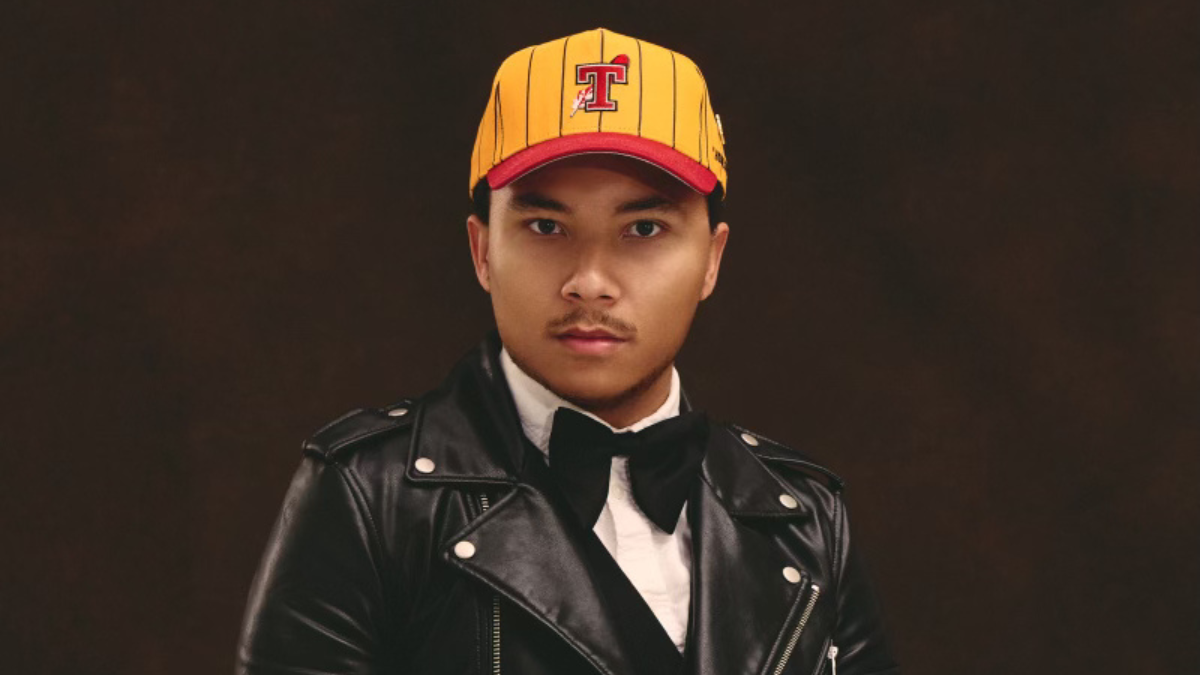
When it comes to preserving the culture and elevating the stories of the South, Noah Washington is a name you need to know. A true multi-hyphenate, the Atlanta-based journalist, playwright, and creative is already making waves across the media landscape.
Whether he is covering vital community stories and politics as a reporter for The Atlanta Voice or driving digital strategy as the Communications & Partnerships Lead at the social media platform Fanbase, Washington is committed to work that informs and uplifts. As the great-great-grandson of visionary educator Booker T. Washington, he naturally carries forward a powerful lineage rooted in empowerment, education, and cultural impact.
Now, he is bringing that legacy to the screen as the host of the Emmy Award-winning WABE and PBS series, (re)Defining History.
The series takes a hands-on approach to uncovering the hidden histories of Atlanta and the broader South, exploring the forgotten figures, cultural icons, and monumental events that shaped the region and the nation. By reexamining these overlooked narratives through a contemporary lens, Washington is doing more than just recounting the past; he is actively putting Atlanta’s rich, often-erased history at the forefront and empowering viewers to redefine how they see the world.
Washington’s dedication to journalism couldn’t come at a more crucial time. As a reporter for The Atlanta Voice, he navigates a complex political climate where authentic Black storytelling is essential.
For Washington, the Black press serves as a vital counter-narrative against modern challenges, such as book bans and regressive legislation, ensuring that marginalized voices are not just heard but thoroughly documented. He views this work not just as a career, but as a necessary public service, a duty he inherited from a family of educators, activists, and public servants.
Beyond traditional media, Washington is keenly focused on the digital frontier. Through his work with Fanbase, he recognizes social media as the “great equalizer,” a powerful tool that eliminates traditional barriers and allows independent Black media platforms to compete alongside centuries-old legacy institutions.
The Quintessential Gentleman recently sat down with Washington to discuss his multifaceted career, the heavy yet rewarding toll of being a Black journalist, and the surreal experience of uncovering his own family’s legacy on national television.
Quintessential Gentleman: Why is Black press so important?
Noah Washington: We’re seeing in real time why Black press is important. With this administration, we’ve been seeing books being banned, right? Legislation passed that takes us back to the 1800s, back when Black press was first invented and the whole entire point of Black press was to be able to authentically tell Black stories and get the news to Black and other marginalized peoples in the world.
QG: How challenging has it been to be not only being a Black journalist, but also to tell our stories in this political climate?
NW: It has its challenges. The biggest thing that I’ve seen is under recognition. There are people all over this world, in Atlanta, in the country, who are just doing amazing things that are not being highlighted in a time where it deserves to be highlighted. On the political side, keeping people informed is paramount to where we are in the state of America right now and that means being able to know both sides of the issues.
QG: Tell us what Redefining History is.
NW: Redefining History is a show that’s produced here in Atlanta by WABE. It airs on WABE TV on YouTube, as well as PBS 30 and PBS Passport. And it’s a series set in the South where I go to different moments in time and history. And I basically tell the stories from my perspective alongside a wonderfully gifted team of people who work for WABE to bring new narratives and new facts to stories that you know about, but may not know the intricate details of.
QG: How did this show come about?
NW: I’m a bit of a playwright. And so in 2023, I did a show called Southern Nights, a play that’s based off the murder of Emmett Till. And then afterwards, me and my producing partner were asked to do a play on the 1906 Atlanta race mass And in the audience was W.A.B.E., and she came up to me and said, “We are launching this new series called Redefining History, and we’d love for you to interview for the show.” And years later, they said, “Hey, Noah, we have a second season, a new batch of episodes, and we want to bring you into the mix, host your own stuff.
QG: What is one big misconception about Atlanta’s history?
NW: I don’t think people realize. And we say it now, but we truly are the center of all industries. The Cotton Stakes Exposition was meant to be the convergence of all these different industries. To talk about how we advance culture and industry in the South. And that right there was the precursor to what we now know as Atlanta today. And it’s just a beautiful thing to see that people that look like you and I were putting in the work back in the 1800s that paid off into the 2020s.
QG: We also can’t talk about history and lineage and not talk about your great-great-grandfather, Booker T. Washington.
NW: The producing team on WABE did not know that relation. So, when I was hired for the job, I happened to mention it, and they said, “You know what, let’s pitch this episode.” Booker Washington, at his height, had a network that rivaled what is the current-day NAACP. He was the man who coined the term “Black Wall Street.” And he did so much for his people, but ultimately became a controversial figure as a result of some of the positions he had to take.
QG: How was it learning more about your ancestry?
NW: It was surreal. There’s a scene in that episode where we’re pulling out the archives and photos of him, photos that I’ve never seen before, illustrations. And the most surreal part about it was I saw my dad. I saw him on Booker. So being able to just see the resemblance… was wild moment, man. Like, I saw my family, right? And just the heavy toll of knowing that this is what my bloodline did was an extraordinary privilege to have.
QG: Why was the South the catalyst for these particular conversations?
NW: The South is huge and I don’t think people really realize the impact or what was coming out of the South. Even today, the South sets the state of everything in America. Music, philosophy, academia. It’s important not to just talk about Atlanta, but talk about the black people in the South and all that it contributed, not to just black culture, but culture, period, man.
QG: What place does social media play in that media space?
NW: Social media is so important, especially how we consume news. It’s the fastest news distributor in the world right now. And even on a social paradigm side, it eliminates the barriers between the people we need to talk to and the community. I call it the great equalizer because now institutions like the Atlanta Voice, Quintessential Gentleman, we can compete with historic institutions that have been around like hundreds of years and really get to tell our stories and meaningful and in the ways that we want to see it.
QG: I want to get your thoughts on influencers as journalists
NW: I think those are two distinct categories, right? A journalist is about that life. The sole mission is to deliver the story in the way it’s meant to be delivered and be a lens through the messages heard. An influencer’s ultimate job… is how can I get my engagement and my followers up so I can ultimately get more money. A journalist is all about getting the message to the people the way that they know how.
QG: What do you want people to get out of watching Redefining History?
NW: I want them to not only bring into observance the stories that I’m telling, but I want them to go and look at the wider breadth of history of how Black people have been instrumental in the development of this country. If you don’t know history, you are doomed to repeat it. And when you lift someone up, you lift yourself up. It’s important that we know this so we can help uplift each other in the trying times that are to come.
Check out the full interview below.