

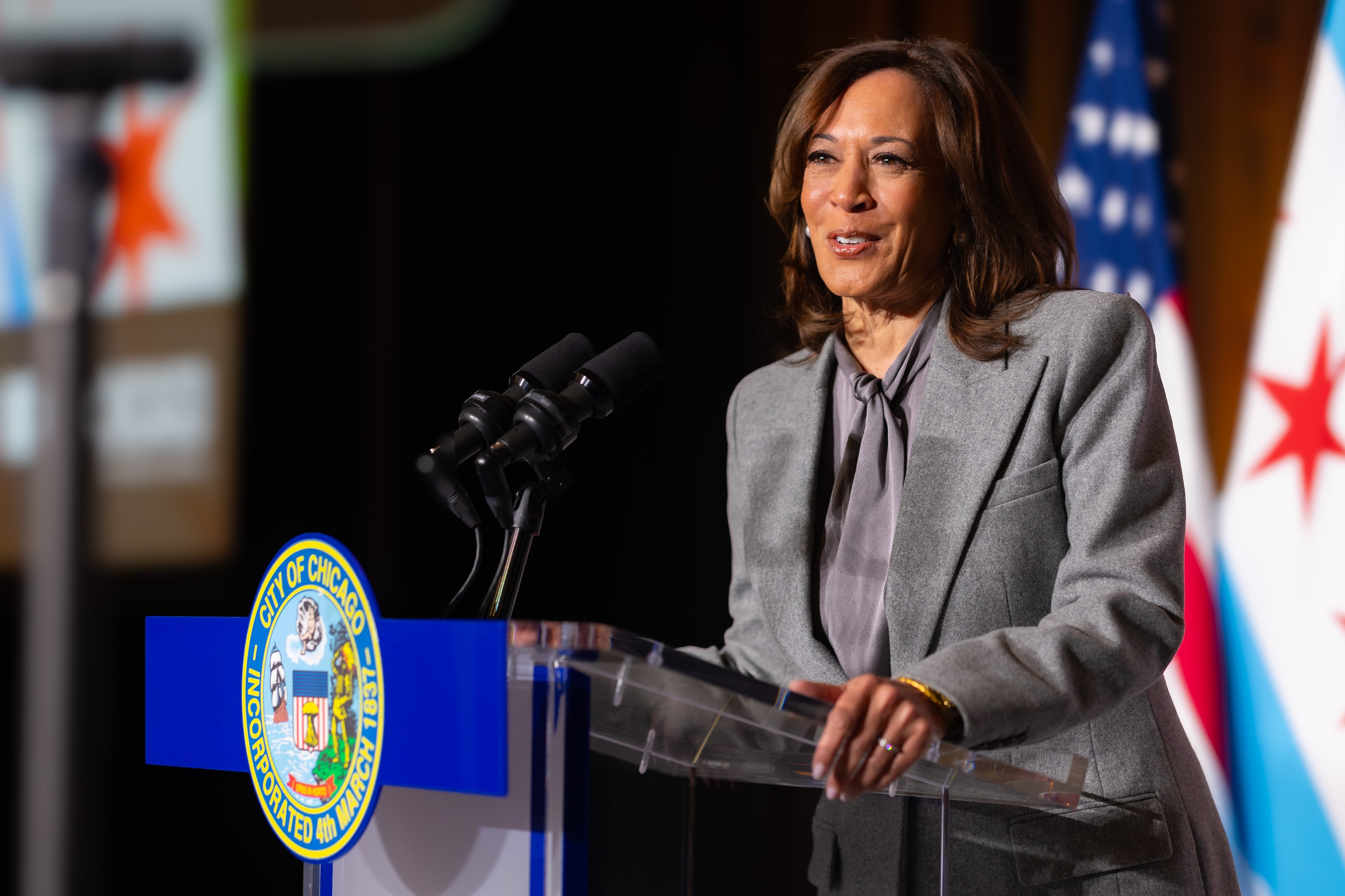
Kamala Harris didn’t hold back in Chicago. Speaking as the keynote address at a Martin Luther King Jr. Day interfaith breakfast, the vice president leaned into a phrase deeply rooted in civil rights history, “people are sick and tired of being sick and tired,” and used it to frame the urgency of the current political moment.
The event marked the 40th anniversary of the gathering and brought together elected officials, faith leaders, activists, and community members from across the city.
Harris opened by honoring the legacy of Dr. King and the generations of organizers who carried his work forward, reminding the audience that King’s love for America was never passive, but rooted in action and accountability.
Harris shared that she arrived in Chicago after visiting the National Civil Rights Museum at the Lorraine Motel in Memphis, a stop that sharpened the parallels between the past and present.
Standing where Dr. King was assassinated, she reflected on the conditions he confronted: segregation, voter suppression, violence, and state-sanctioned injustice, and the resolve of a people who refused to accept it as inevitable.
That reflection became the backbone of her message. “The people were sick and tired of being sick and tired,” Harris said, invoking the same words that once fueled lunch counter sit-ins, bus boycotts, and mass organizing efforts.
For Harris, that sentiment isn’t confined to history books; it’s alive right now.
She pointed to what she described as modern-day echoes of those struggles: attempts to undermine voting rights, distrust in election systems, family separations driven by immigration enforcement, rising costs that force families into impossible choices, and the spread of misinformation through social media.
In each example, Harris returned to the same refrain: people are exhausted, angry, and frustrated, and for good reason.
Her remarks also directly challenged recent claims that framed the Civil Rights Movement as “reverse discrimination,” positioning those comments as part of a broader effort to roll back hard-fought progress. Harris argued that such rhetoric ignores both historical truth and present-day realities, particularly for communities still navigating systemic inequities.
Still, the speech wasn’t a call for despair.
Harris acknowledged the fatigue many Americans feel, citing isolation, cynicism, and apathy, but urged the audience not to mistake exhaustion for powerlessness. Instead, she framed this moment as one that demands participation rather than retreat. “This is a moment not to throw up our hands,” she said, “but a moment to roll up our sleeves.”
That work, Harris emphasized, includes organizing, registering voters, speaking truthfully, and showing up even when the weight of the moment feels heavy. She praised Chicago’s long history of political engagement and resistance, noting that the city understands what sustained commitment looks like, not just in moments of inspiration, but across years of pressure and pushback.
By the time Harris closed her remarks, the message was clear: frustration is justified, but disengagement is not. The same collective power that reshaped America during the Civil Rights Movement remains available today, if people are willing to tap into it.
Check out her full speech below.
Photo Credit: X/ChicagosMayor